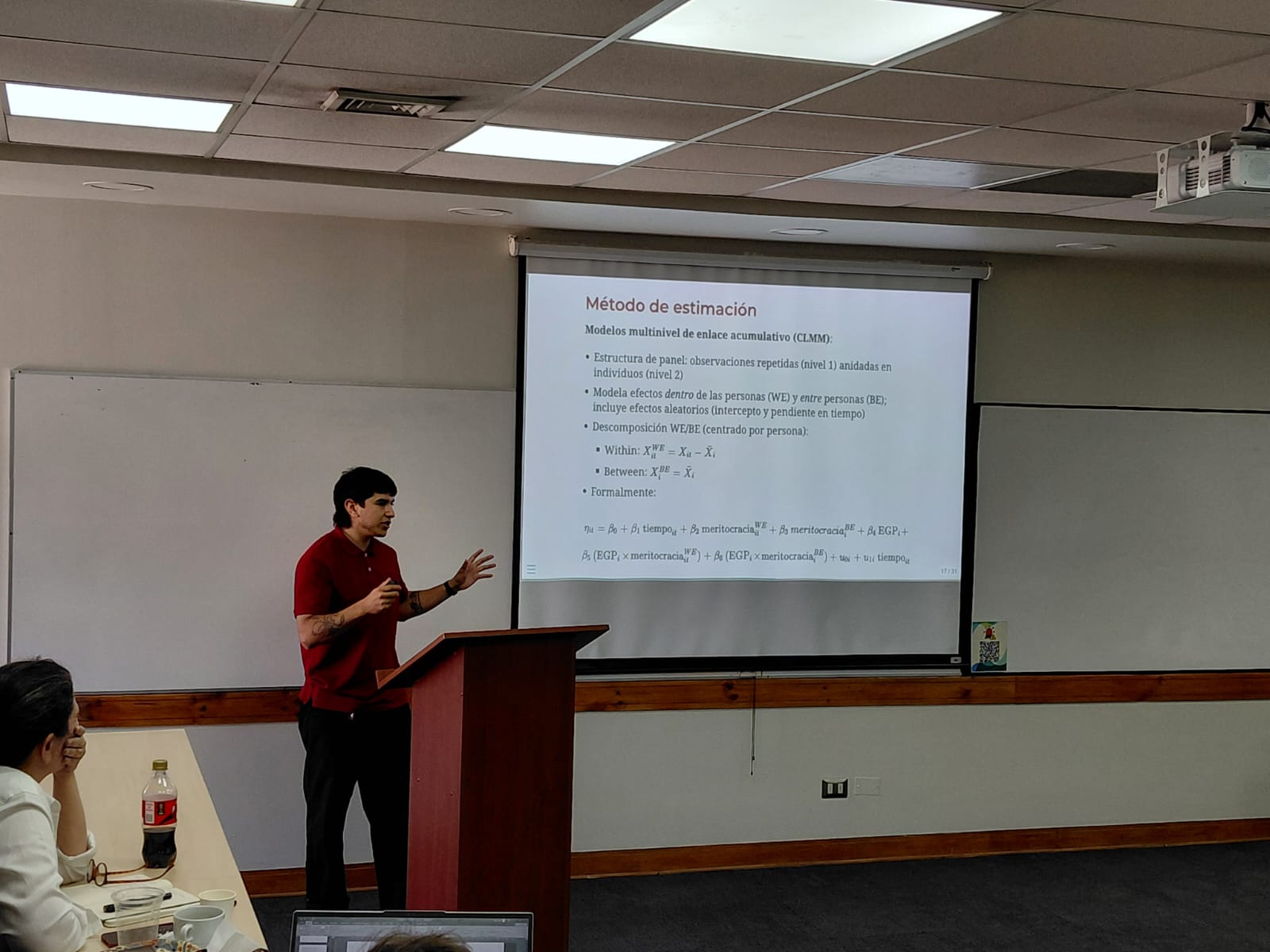

Presentación en el Workshop Online WARN 2026
El lunes 29 de junio de 2026, el equipo JUSMER participó en el WARN Online Workshop: Methods in Welfare Attitudes Research, organizado por la Welfare Attitudes Research…
| Title | Authors | Descripcion | publication |
|---|---|---|---|
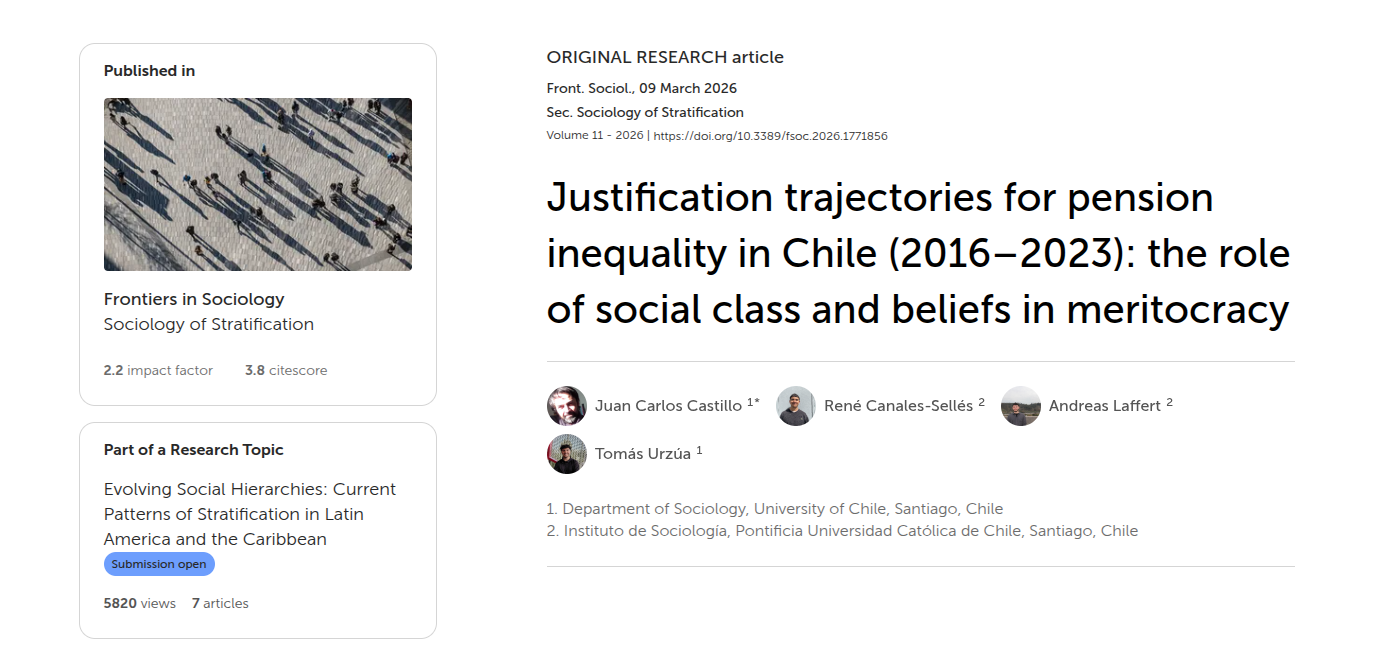
| Justification Trajectories for Pension Inequality in Chile (2016–2023): The Role of Social Class and Beliefs in Meritocracy | Introduction The Chilean pension system, characterized by full privatization and individual capitalization, plays a central role in shaping old-age inequality. Despite widespread social unrest and demands for reform, a segment of the population continues to justify income-based pension differences, a phenomenon conceptualized as preferences for pension market justice. This study investigates the interplay between social class, meritocratic beliefs (distinguishing between effort and talent), and preferences for market justice in the Chilean pension system between 2016 and 2023. Methods Using six waves of panel data from the Chilean Longitudinal Social Survey-ELSOC ( N observations = 5,755; N individuals = 1,027), the analysis employs Cumulative Link Mixed Models (CLMM) to examine longitudinal changes. This approach allows for the decomposition of variance into between-person and within-person effects, assessing how stable class positions and evolving meritocratic perceptions influence the legitimacy of market-based pension allocation. Results The findings reveal a “class neutralization” phenomenon, where objective social class does not significantly predict support for pension market justice. Instead, support has grown across all groups. Meritocratic perceptions of effort are consistently associated with higher market justice preferences at both between- and within-person levels. Conversely, talent-based perceptions do not show a main effect but interact significantly with Specific Class Positions: they predict higher support among the intermediate class (between-person) and among unemployed individuals whose perceptions of talent rewards increase over time (within-person). Discussion These findings suggest that the institutional architecture of the pension system frames outcomes as results of individual responsibility, dampening class-based redistributive demands. Effort-based meritocracy acts as a key legitimizing ideology for pension inequality. However, talent-based justifications appear to function differently, serving as a compensatory narrative for the intermediate class and the unemployed to rationalize distributive outcomes in a context where the link between effort and reward is structurally constrained. | Frontiers in Sociology, 11 1771856 https://doi.org/10.3389/fsoc.2026.1771856 | |
| Stability and Comparability of Meritocratic Beliefs in School-Age Students: A Measurement Invariance Approach across Time and Cohorts | Meritocratic beliefs shape how adolescents understand inequality and the legitimacy of social arrangements. Schoolsare key sites of meritocratic socialization, making adolescence a crucial period for studying how these beliefs are formed.However, research on adolescents’ meritocratic beliefs has often relied on unidimensional measures that conflate perceptionsof how allocation works with preferences about how it should work and treat meritocratic and non-meritocratic principles asopposites. This study tests a multidimensional model that distinguishes between perceived and preferred meritocracy and non-meritocracy. Using two-wave panel survey data from Chilean students in 8th and 10th grade (Wave 1: N = 846; Wave 2: N= 662), we assess whether these dimensions can be distinguished, compared across school stages, and measured equivalentlyover time. Results support a four-factor structure and show that endorsement of merit can coexist with recognition of non-meritocratic advantage. The scale achieves strict longitudinal invariance within students but not across school levels. | : SocArXiv https://doi.org/10.31235/osf.io/gvbqw_v1 | |
| Changes in the Justification of Educational Inequalities: The Role of Perceptions of Inequality and Meritocracy During the COVID Pandemic | (Abstract not available) | Social Justice Research, 38(3) 240–263 https://doi.org/10.1007/s11211-025-00458-0 | |
| Perceptions of Inequality and Meritocracy: Their Interplay in Shaping Preferences for Market Justice in Chile (2016–2023) | Introduction Several countries have experienced a shift toward the privatization and commodification of public goods, welfare policies, and social services. In Latin America, Chile stands out as a paradigmatic case where this trend has led to the extensive marketization of essential services. From a moral economy perspective, the extent to which individuals consider it fair for access to such services to depend on market criteria has been conceptualized as market justice preferences. This study investigates the relationship between perceptions of economic inequality, meritocratic beliefs, and market justice preferences in Chile between 2016 and 2023. Methods Using six waves of panel data from the Chilean Longitudinal Social Survey-ELSOC (Nobservations = 8,643; Nindividuals = 1,687), the analysis examines how subjective assessments of inequality shape attitudes toward the role of merit in access to key social services such as healthcare, education, and pensions. Results The findings show that greater perceived inequality is associated with lower market justice preferences. However, individuals who believe that effort is rewarded are more likely to legitimize existing disparities. In contrast, the perception that talent is rewarded shows a negative effect on market justice preferences; an effect that intensifies as perceived inequality increases over time. The study also considers the influence of major social movements during this period, which appear to have reshaped public discourse on justice and fairness. Discussion These findings contribute to a deeper understanding of how distributive beliefs evolve in contexts marked by persistent inequality and entrenched neoliberal frameworks. They indicate that while perceptions of inequality tend to undermine support for market justice, meritocratic beliefs-particularly those emphasizing effort-reinforce its legitimacy. By contrast, talent-based meritocratic perceptions weaken it, especially as inequality becomes more salient. The results also suggest that major collective events, such as the 2019 protests, did not fundamentally alter these underlying associations. | Frontiers in Sociology, 10 1634219 https://doi.org/10.3389/fsoc.2025.1634219 |
| Author | Title | Event |
|---|---|---|
| Justification Trajectories for Pension Inequality in Chile (2016-2023): The Role of Social Class and Beliefs in Meritocracy | InEquality Conference. Panel 17: Meritocracy and Inequality Beliefs. Universitat Konstanz | |
| Stability and Comparability of Meritocratic Beliefs in School-Age Students: A Measurement Invariance Approach across Time and Cohorts | : SocArXiv https://doi.org/10.31235/osf.io/gvbqw_v1 | |
| Design of a Conjoint Survey Experiment: Inequality and Deservingness in Higher Education in Chile | Workshop on Experimental Approaches to Redistribution and Deservingness . Chile | |
| Preferences for Market-Based Welfare: Disentangling the Role of Merit and Privilege Beliefs in Chile | WARN Online Workshop: Methods in Welfare Attitudes Research |

Investigador Principal

Asistente de investigación

Investigador asociado

Investigador asociado

Investigador asociado

Tesista

Tesista

Tesista