Market Justice and Deservingness of Social Welfare

FONDECYT Grant 2025-2029


Juan Carlos Castillo

Tomás Urzúa

Department of Sociology, University of Chile


August 2026 - University of Chile

Research project

Project

  • ANID/FONDECYT N°1250518 2025-2029 - Market Justice and Deservingness of Social Welfare

  • Objective: Analyze market justice preferences in Chile, their evolution over time, and their relation to welfare deservingness

  • Main argument: Chile’s highly commodified welfare system strengthens meritocratic deservingness beliefs, thereby increasing preferences for market justice relative to less commodified contexts

  • Research design:

    • Comparative and longitudinal data analysis
    • Original survey
    • Survey experiments
    • Legislative debates on pensions

Previous Team

Andreas Laffert, Tomás Urzúa, Juan Carlos Castillo, René Canales

Current team

Tomás Urzúa, Juan Carlos Castillo

Gathering the pieces

Peer reviewed Articles

  • Castillo, J. C., Iturra, J., Maldonado, L., Atria, J., & Meneses, F. (2023). A Multidimensional Approach for Measuring Meritocratic Beliefs: Advantages, Limitations and Alternatives to the ISSP Social Inequality Survey. International Journal of Sociology, 53(6), 448–472. https://doi.org/10.1080/00207659.2023.2241875

  • Castillo, J. C., Salgado, M., Carrasco, K., & Laffert, A. (2024). The Socialization of Meritocracy and Market Justice Preferences at School. Societies, 14(11), 214. doi.org/10.3390/soc14110214

  • Castillo, J. C., Laffert, A., Carrasco, K., & Iturra-Sanhueza, J. (2025). Perceptions of inequality and meritocracy: their interplay in shaping preferences for market justice in Chile (2016–2023). Frontiers in Sociology, 10, 1634219. https://doi.org/10.3389/fsoc.2025.1634219

  • Castillo, Juan Carlos; Iturra, Julio & Carrasco, Kevin (2025). Changes in the Justification of Educational Inequalities: The Role of Perceptions of Inequality and Meritocracy During the COVID Pandemic. Social Justice Research, 38(3) 240–263 https://doi.org/10.1007/s11211-025-00458-0

  • Castillo, J. C., Canales Sellés, R., Laffert, A., & Urzúa, T. (2026). Justification trajectories for pension inequality in Chile (2016–2023): the role of social class and beliefs in meritocracy. Frontiers in Sociology, 11, 1771856. https://doi.org/10.3389/fsoc.2026.1771856

Forthcoming

  • Stability and comparability of meritocratic beliefs in school-age students: A measurement invariance approach across time and cohorts. Andreas Laffert, Juan Carlos Castillo, René Canales, Tomás Urzúa & Kevin Carrasco. Submited.

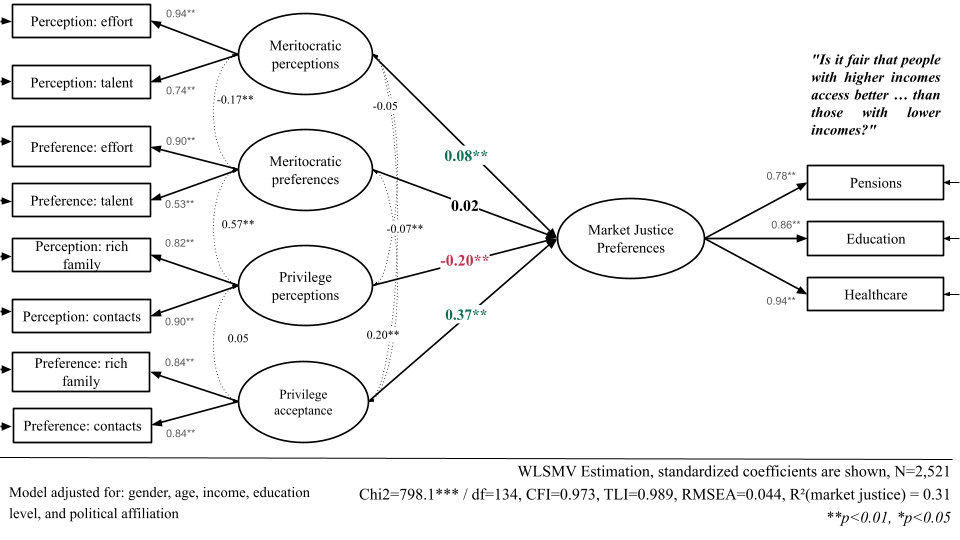
  • Market justice and meritocracy: A structural equation modeling approach. Andreas Laffert, Tomás Urzúa, Juan Carlos Castillo & René Canales.

  • Inequality and deservingness in higher education in Chile. A conjoint survey experiment. Juan Carlos Castillo, Andreas Laffert, René Canales & Tomás Urzúa.

  • Objective and subjective status: their interplay with market justice preferences in a comparative perspective. Juan Carlos Castillo, Tomás Urzúa

  • Market justice preferences in education: The role of meritocratic beliefs in the chilean context. Tomás Urzúa, Juan Carlos Castillo

Background

The Chilean case

  • Chile combines high inequality with limited upward mobility and strong elite closure (Flores, Sanhueza, Atria, & Mayer, 2020; López-Roldán & Fachelli, 2021; Torche, 2014)

  • Since the dictatorship (1973-1989), neoliberal reforms have deeply privatized and commodified key social services, while preserving strong state dependence (Madariaga, 2020)

  • Pensions: a mandatory individual capitalization system administered by private pension funds (AFP’s) (Superintendencia, 2025)

  • Health: a dual system of public and private insurance, with the public system (FONASA) covering 70% of the population (Superintendencia, 2025)

  • Education: a triple highly stratified system of public, subsidized private, and private schools, with significant disparities in quality and access

The problem

  1. Privatization and marketization of public goods, welfare policies, and social services (Gingrich, 2011; Streeck, 2016)
  1. Changes in the institutional architecture of the welfare state; expansion of market logics (Busemeyer & Iversen, 2020; Ferre, 2023)
  1. This economic order is reflected in a specific moral economy and policy feedback dynamics (Campbell, 2020; Fernandez & Jaime-Castillo, 2013; Mau, 2015)

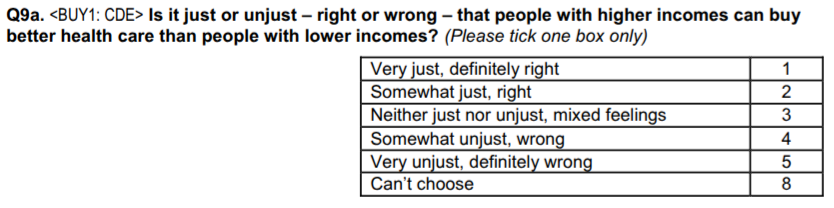
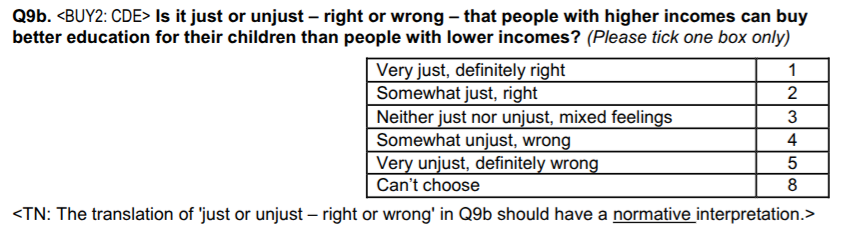
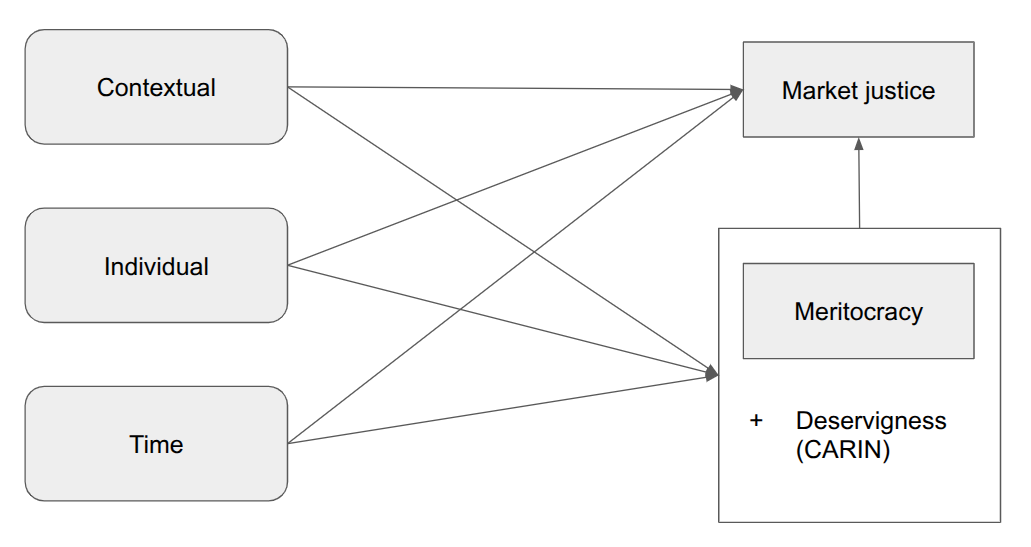
Market justice preferences

Classical survey items for market justice (ISSP)

Factors associated with market justice

Individual

Contextual

Meritocracy, deservingness, and market justice

Including meritocracy

  • Merit = talent + effort (Young, 1958)

  • Believing in meritocracy has been associated with tolerance and acceptance of inequality (Mijs, 2019; Sandel, 2020)

  • We argue that meritocratic beliefs are a relevant driver of market justice preferences, as it provides a moral justification for the unequal distribution of resources and opportunities in society.

  • but, what are meritocratic beliefs?

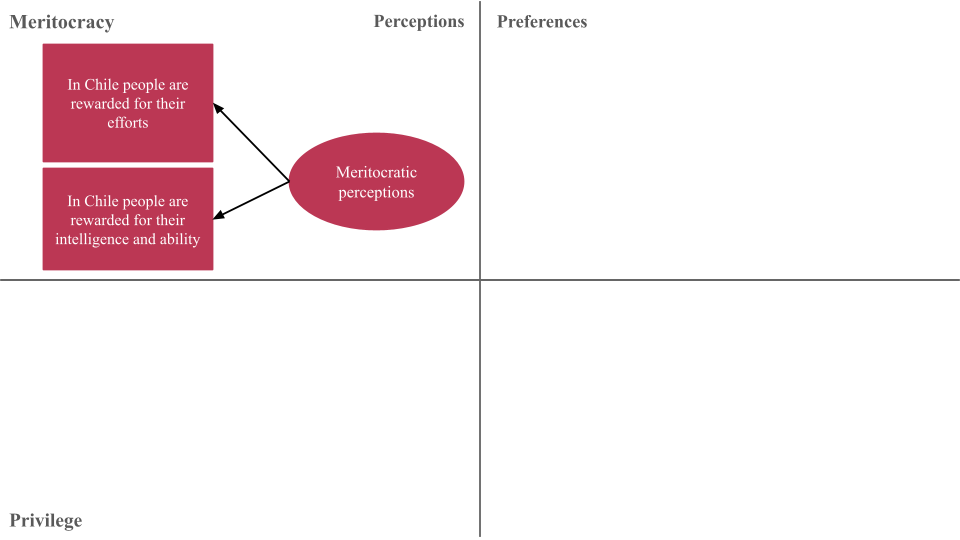
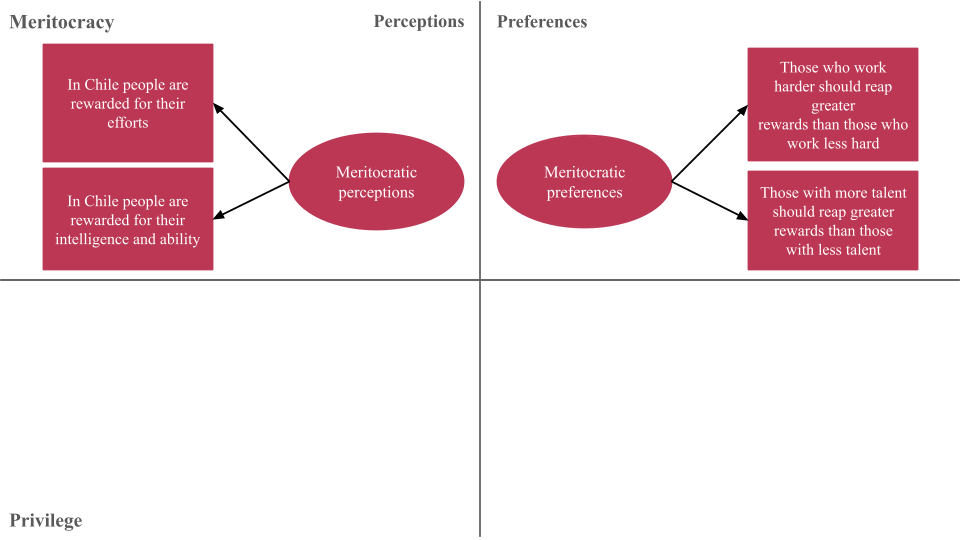
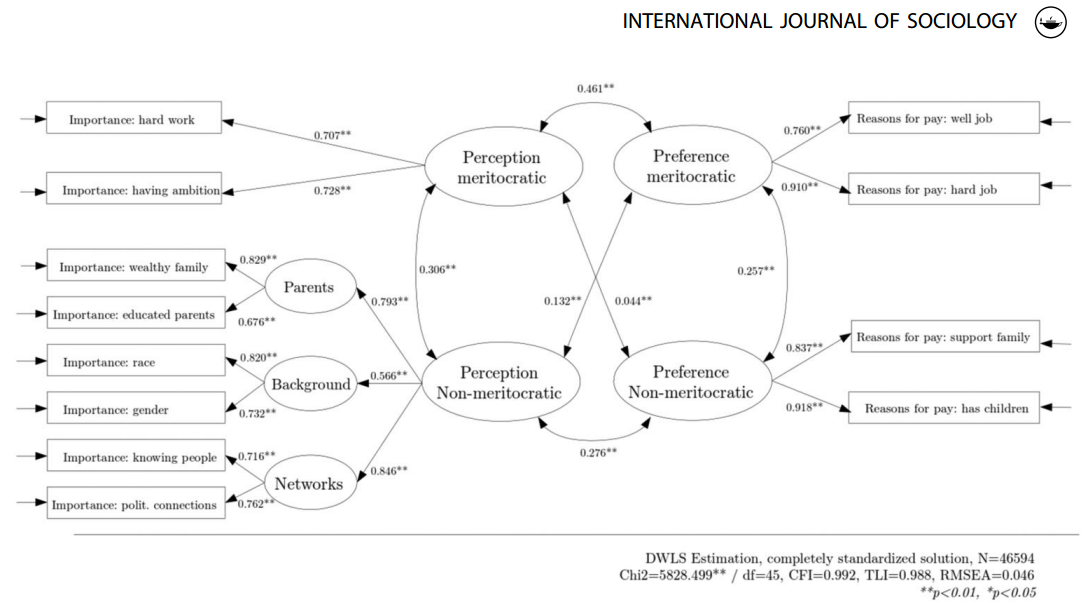
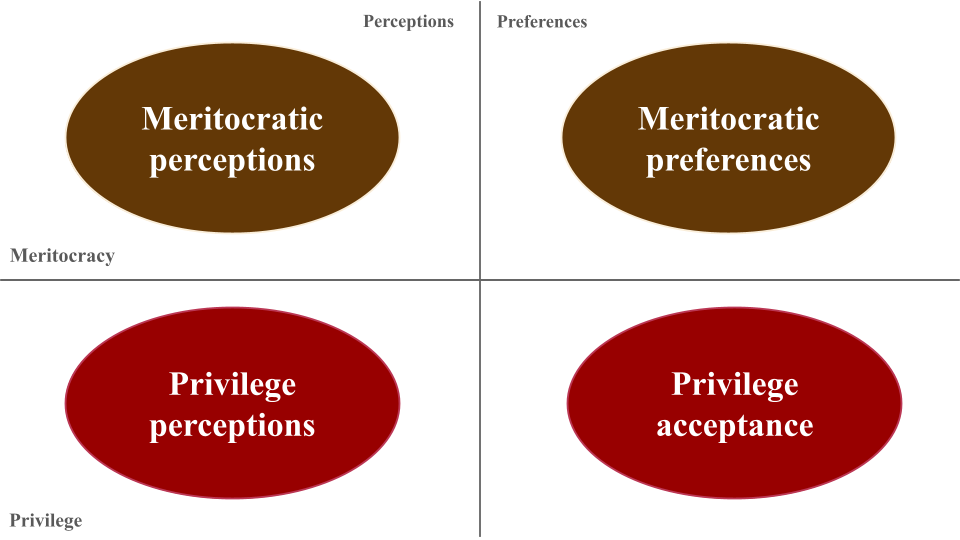
Multidimensional framework of meritocracy

Castillo et al. (2023) conceptual model

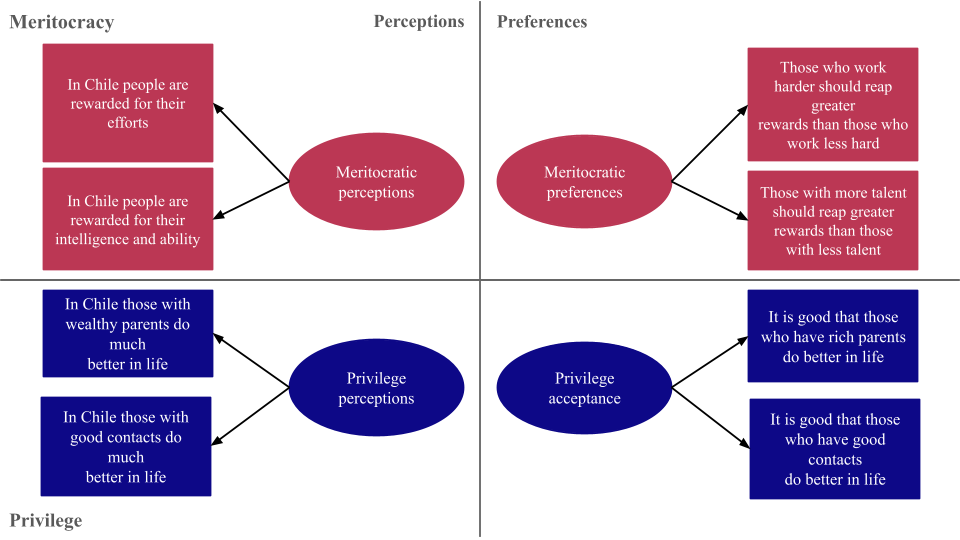
Multidimensional framework of meritocracy

Castillo et al. (2023) conceptual model

Multidimensional framework of meritocracy

Castillo et al. (2023) conceptual model

Multidimensional framework of meritocracy

Castillo et al. (2023) conceptual model

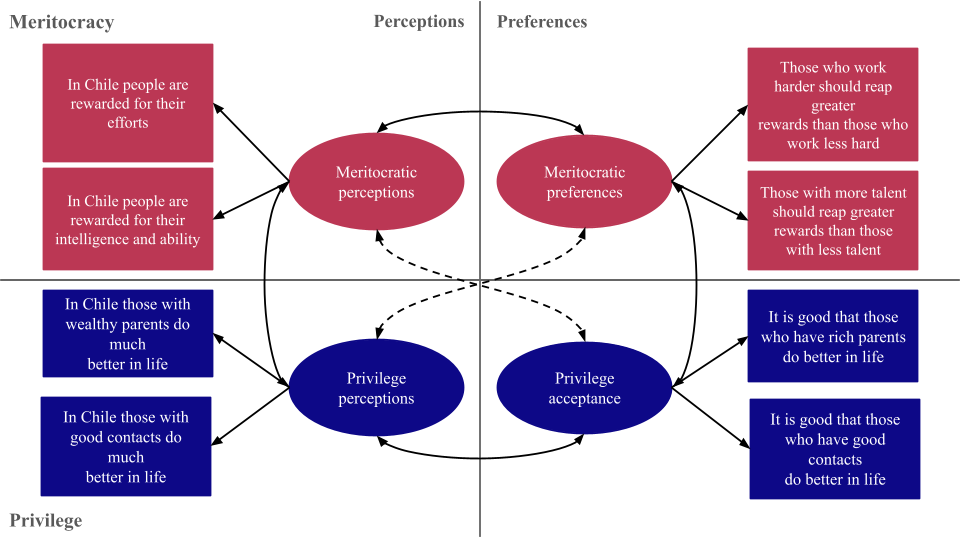
Multidimensional framework of meritocracy

Castillo et al. (2023) conceptual model

Incorporating deservingness criteria

  • Merit beliefs can be conceived as one of several criteria in terms of deservingness of social goods

  • The deservingness literature (Knotz, Gandenberger, Fossati, & Bonoli, 2022; Meuleman, Roosma, & Abts, 2020; Oorschot, 2000) had the advantage that

    • expands de criteria for public goods allocation

    • connected to welfare state literature

  • A wider framework for understanding the relationship between meritocracy, redistribution, and inequality legitimation.

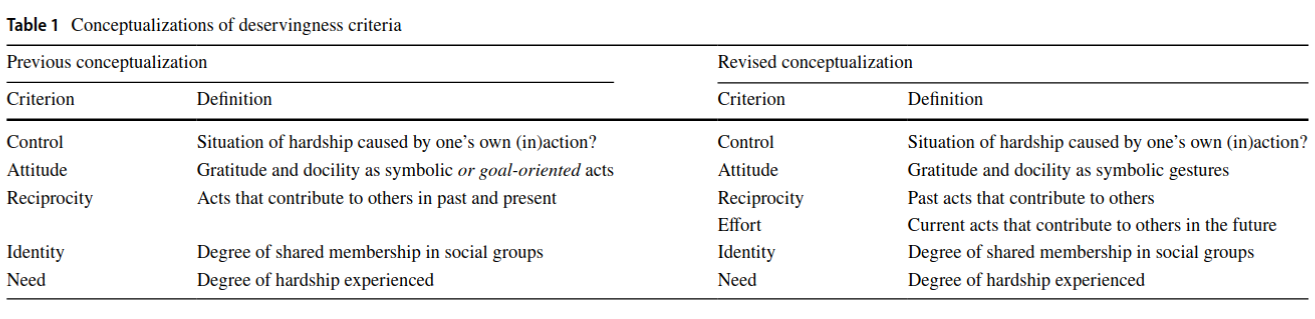
Deservingness frameworks

CARIN (Meuleman, Roosma, & Abts, 2020; Oorschot, 2000) + Knotz, Gandenberger, Fossati, & Bonoli (2022) frameworks:

An attempt of a whole picture

Some studies

A. Multidimensional meritocracy

B. Market justice preferences & meritocracy

C. Market justice preferences & deservingness (ongoing)

Some studies

A. Multidimensional meritocracy

B. Market justice preferences & meritocracy

C. Market justice preferences & deservingness (ongoing)

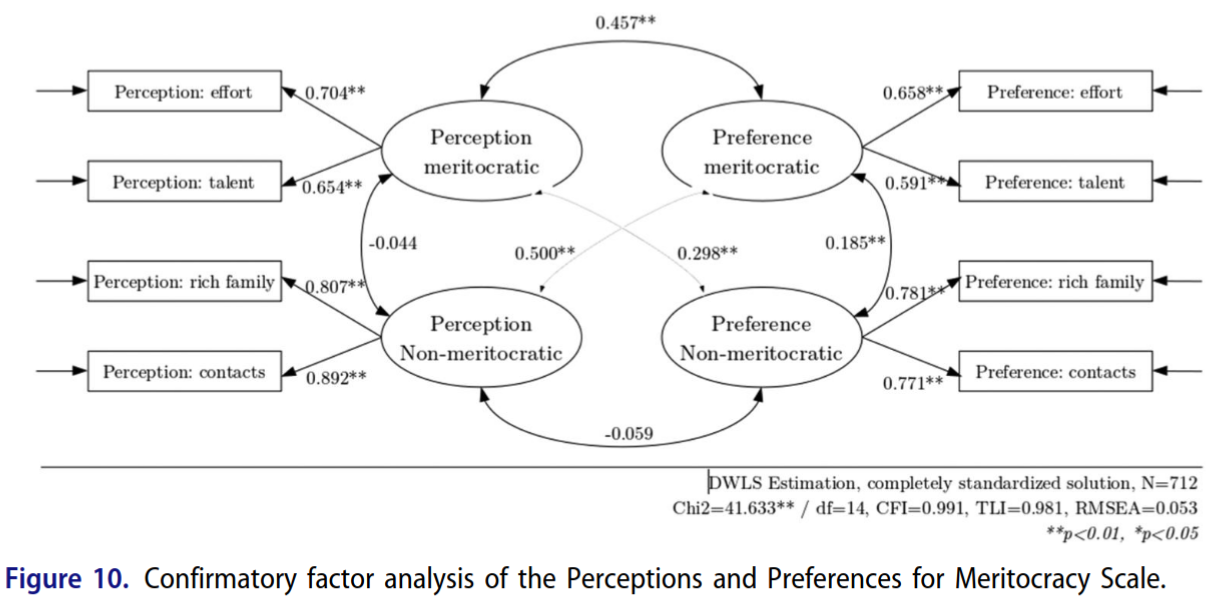
Castillo, J. C., Iturra, J., Maldonado, L., Atria, J., & Meneses, F. (2023). A Multidimensional Approach for Measuring Meritocratic Beliefs: Advantages, Limitations and Alternatives to the ISSP Social Inequality Survey. International Journal of Sociology, 53(6), 448–472. https://doi.org/10.1080/00207659.2023.2274712

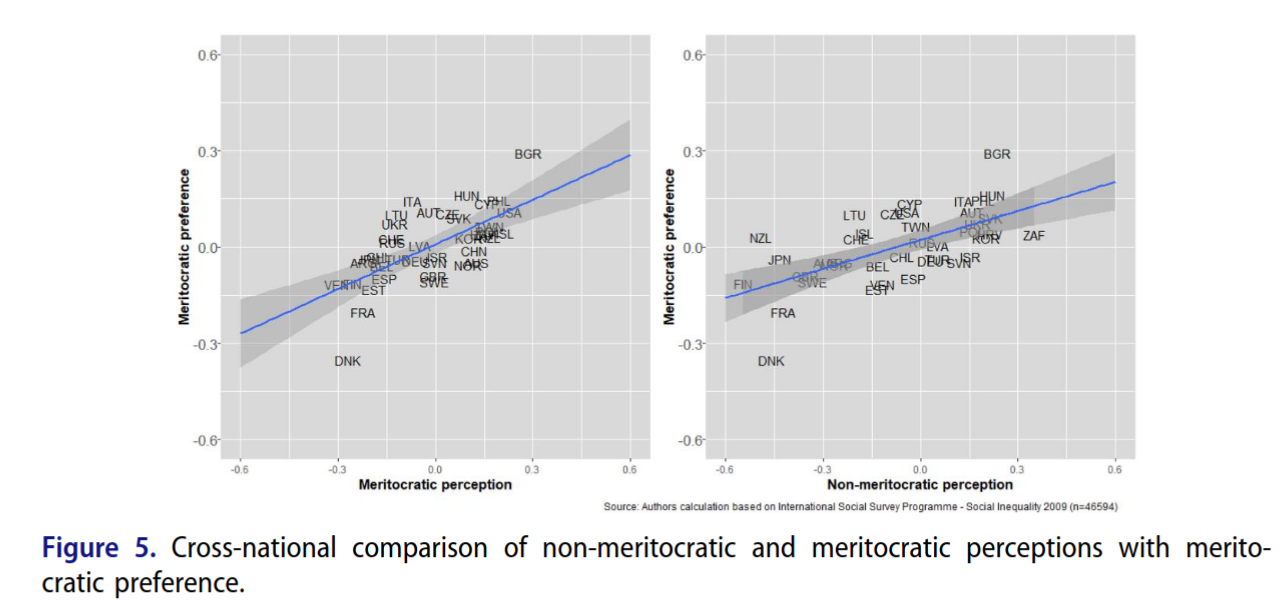
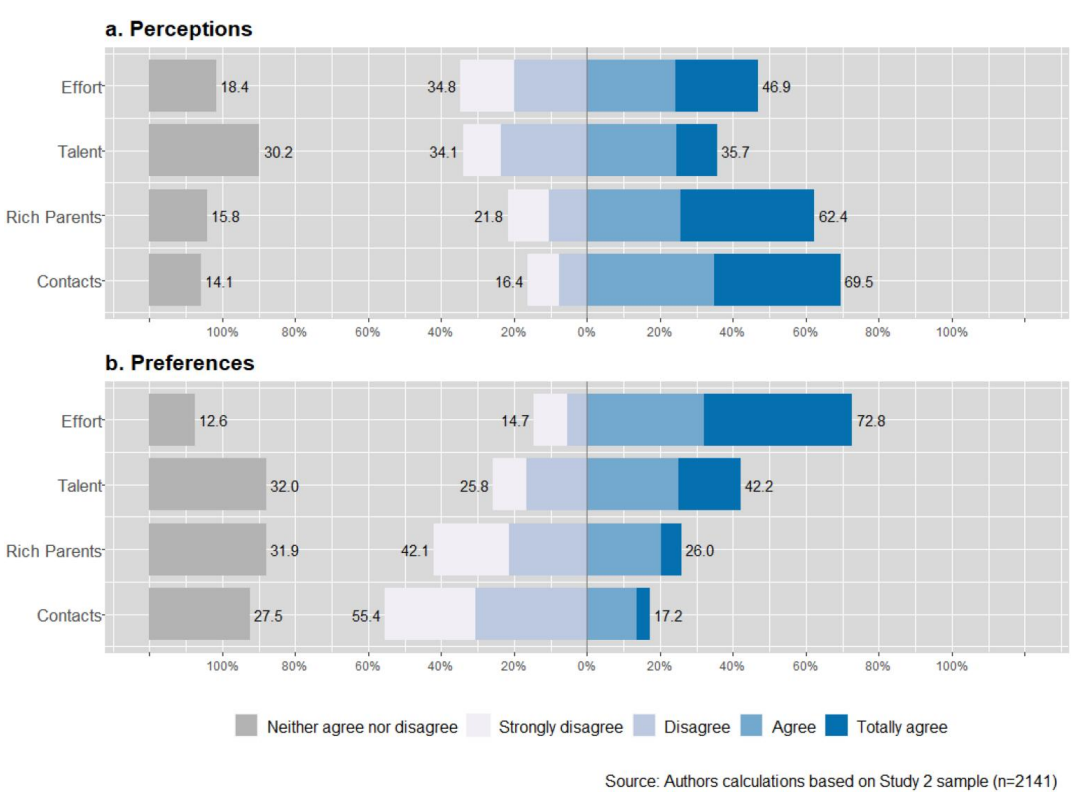
Castillo et al, (2023)

Castillo et al, (2023)

Castillo et al, (2023)

Castillo, Urzúa, Laffert, Canales & Carrasco (2026)

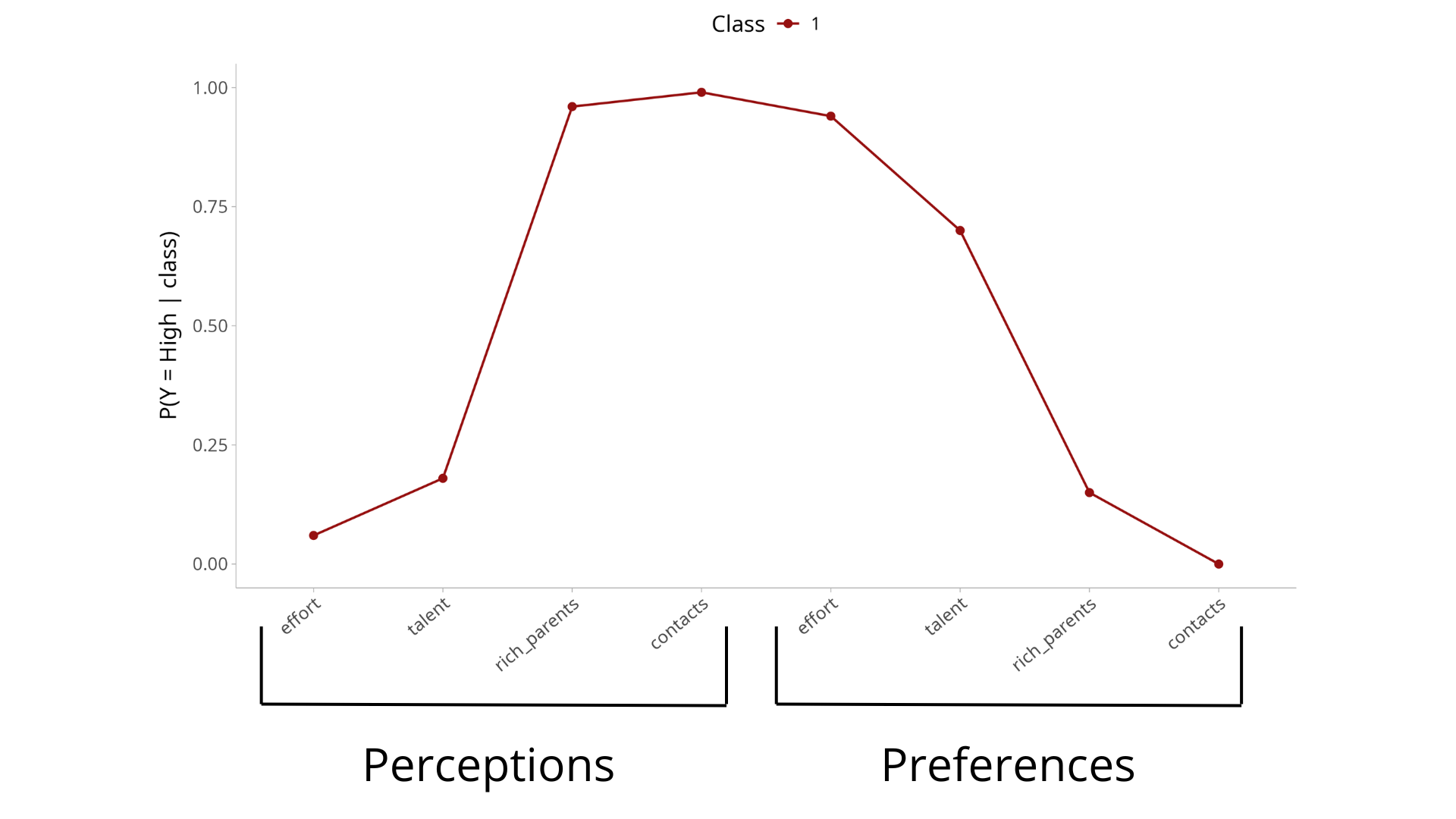
Latent Class Analysis

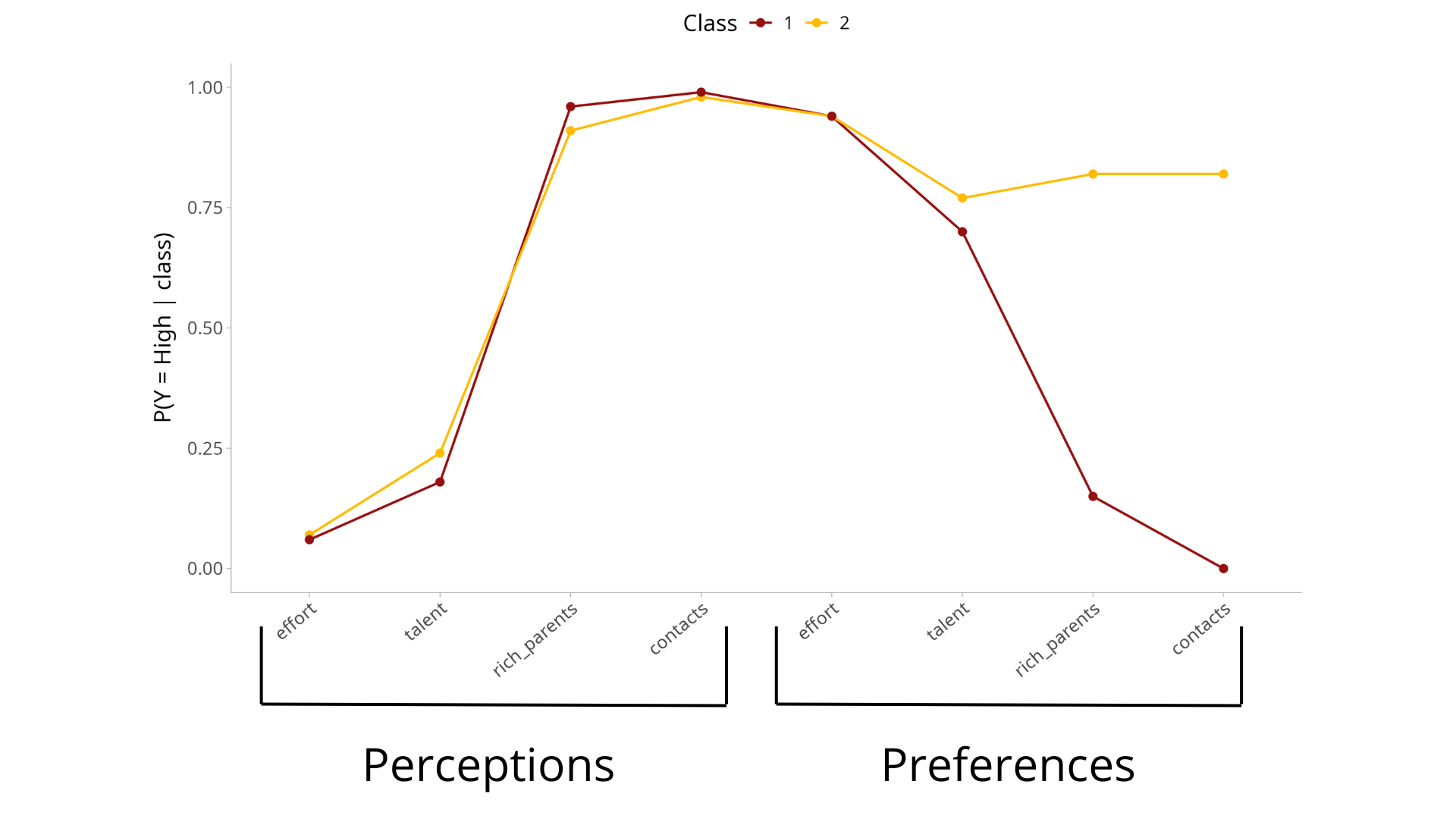
Figure 1: Conditional probabilities of the 4-class solution. EDUMERCO data (N = 2470)
  • Class 1 Critical Meritocrats (36.2%)

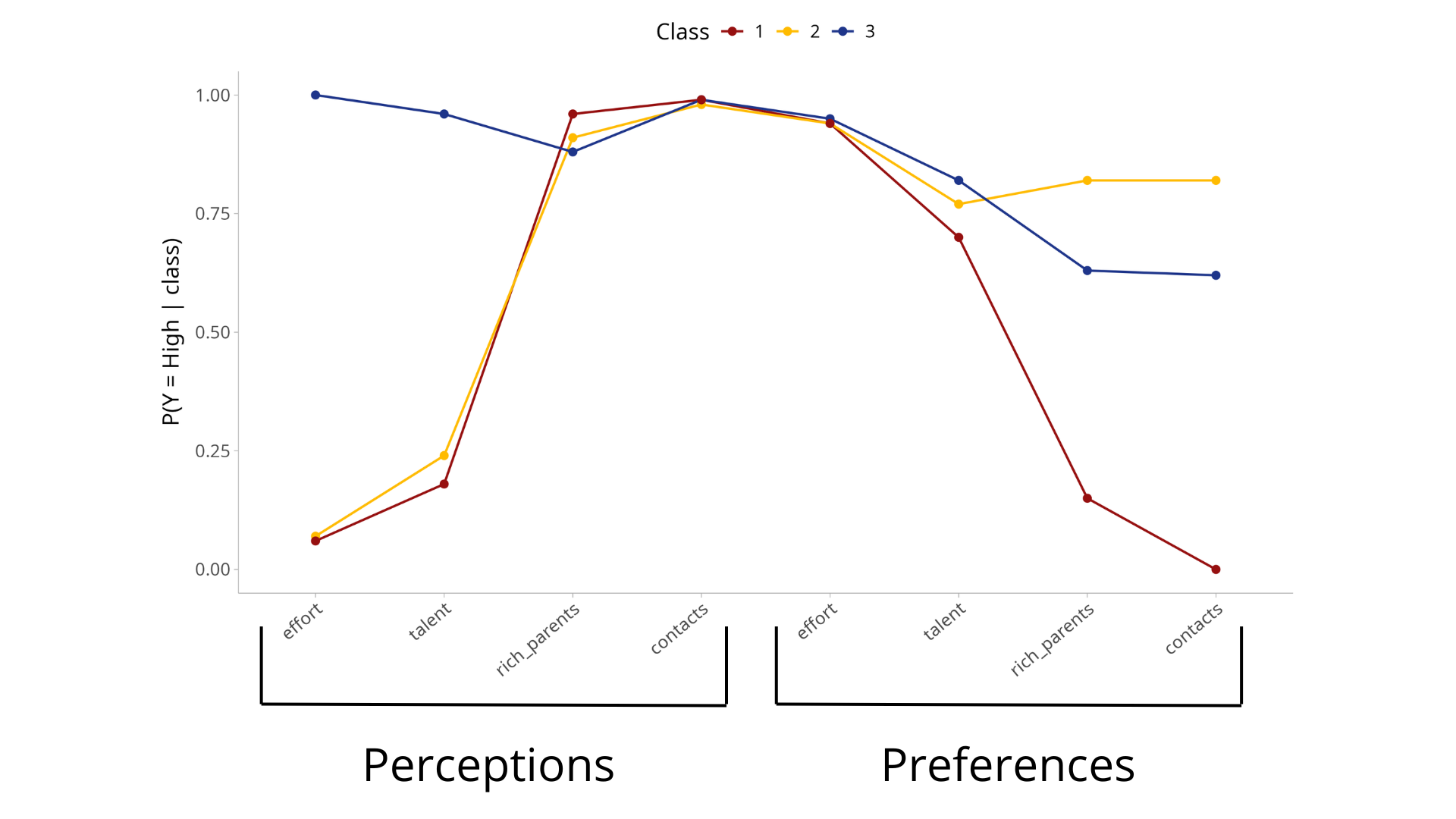
Figure 2: Conditional probabilities of the 4-class solution. EDUMERCO data (N = 2470)
  • Class 2: Privilege advocates (36.3%)

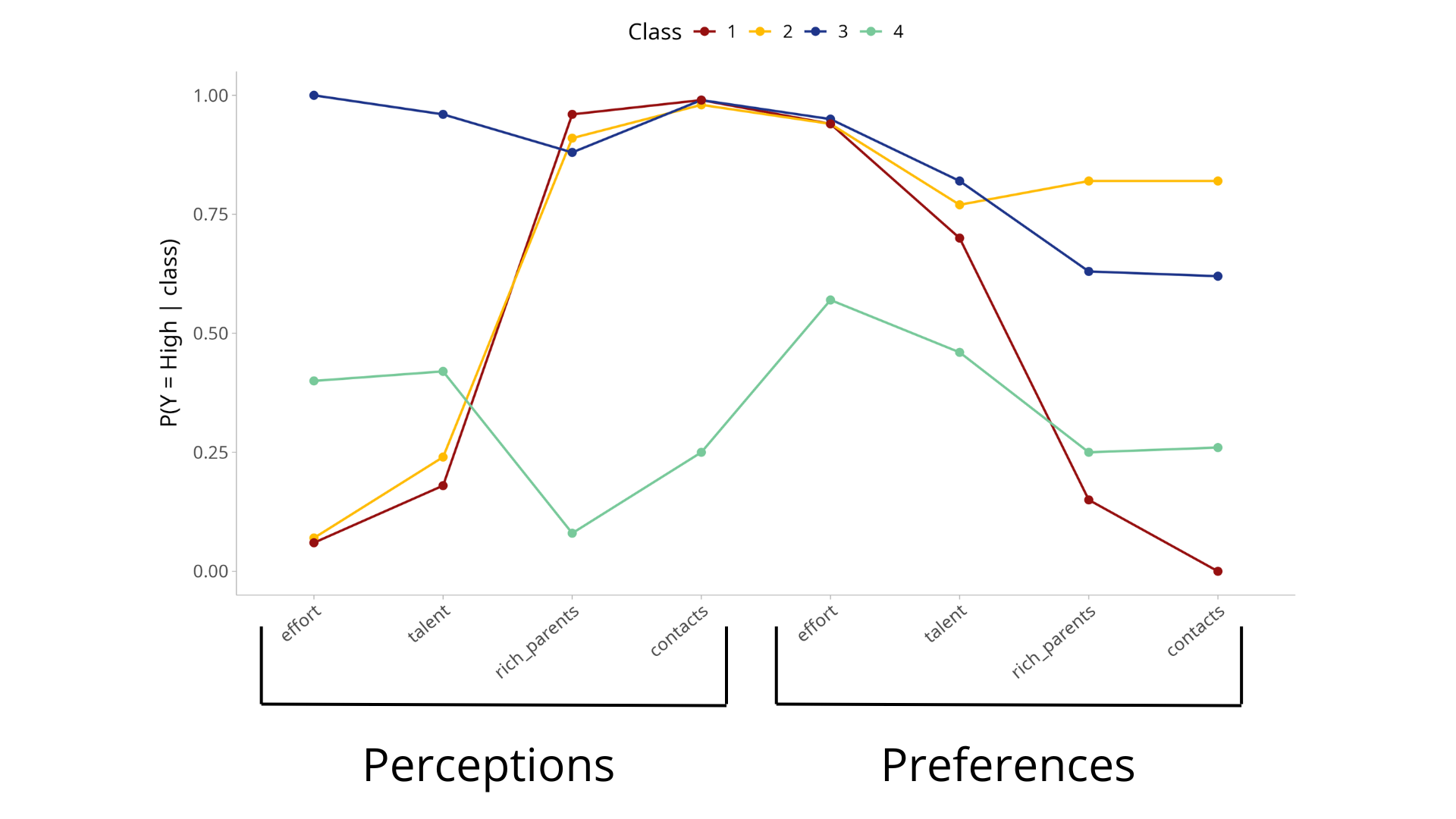
Figure 3: Conditional probabilities of the 4-class solution. EDUMERCO data (N = 2470)
  • Class 3 Universal rewards (20.7%)

Figure 4: Conditional probabilities of the 4-class solution. EDUMERCO data (N = 2470)
  • Class 4 Against privilege (6.8%)

Some studies

A. Multidimensional meritocracy

B. Market justice preferences & meritocracy

C. Market justice preferences & deservingness (ongoing)

Market justice over time

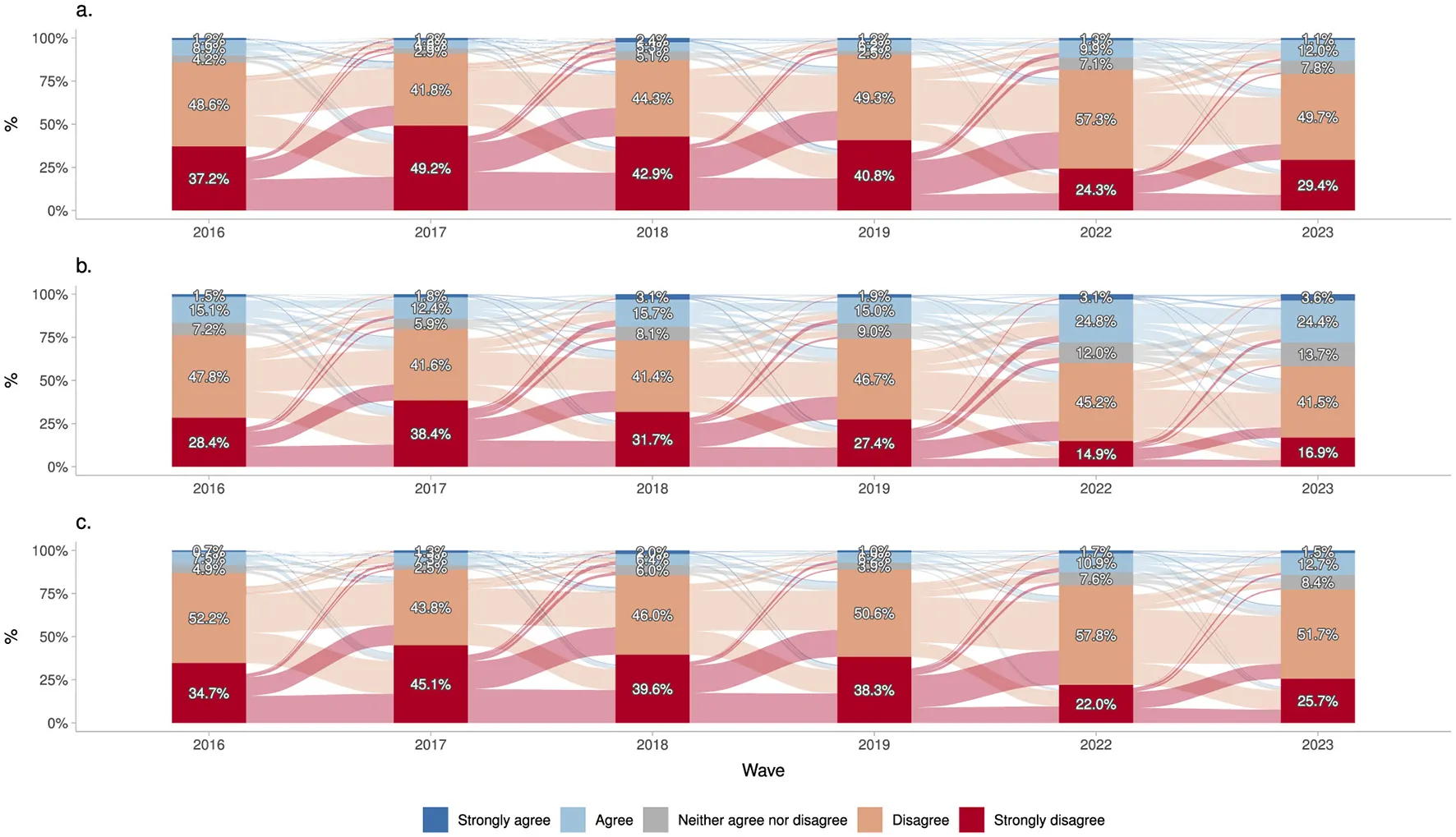
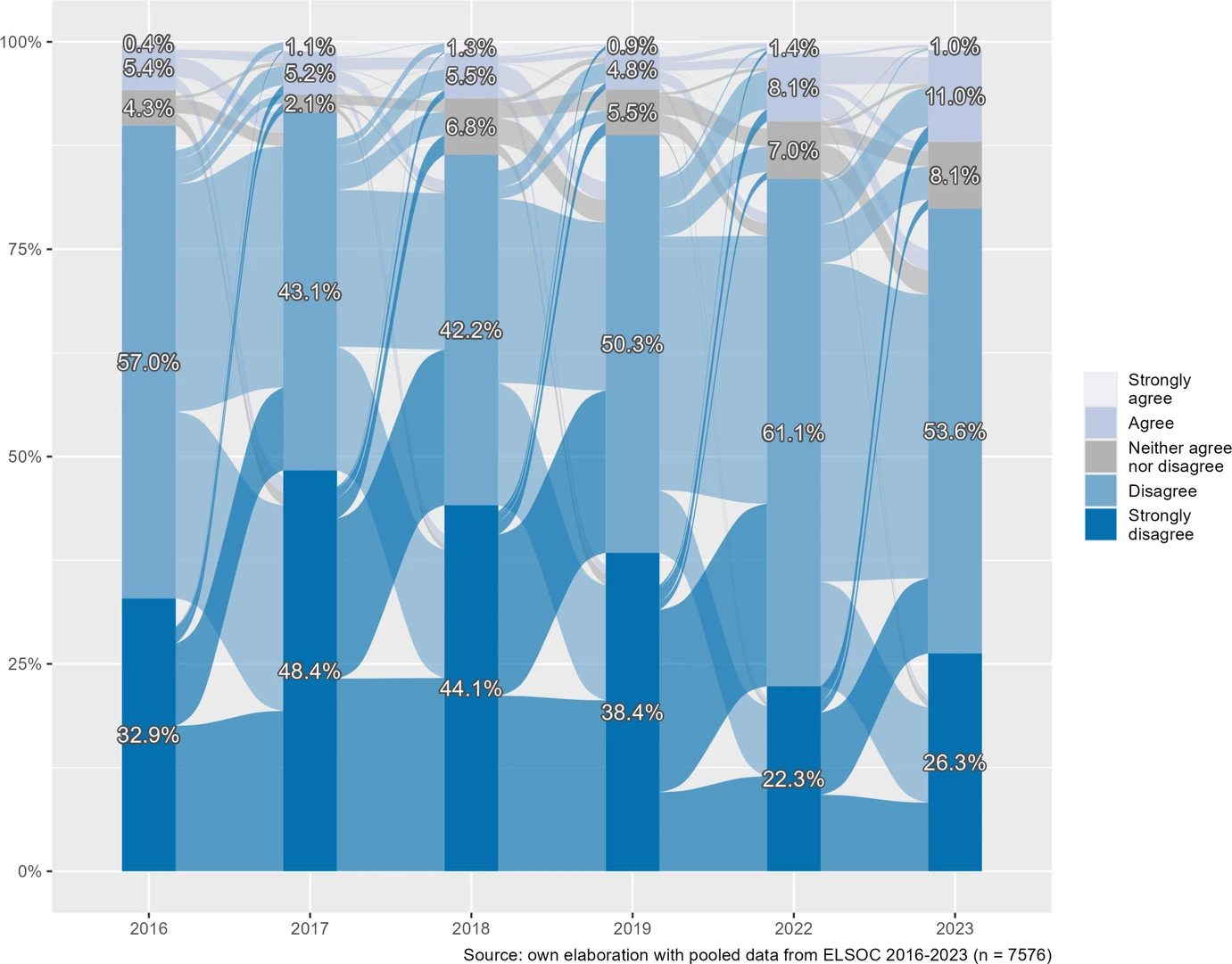
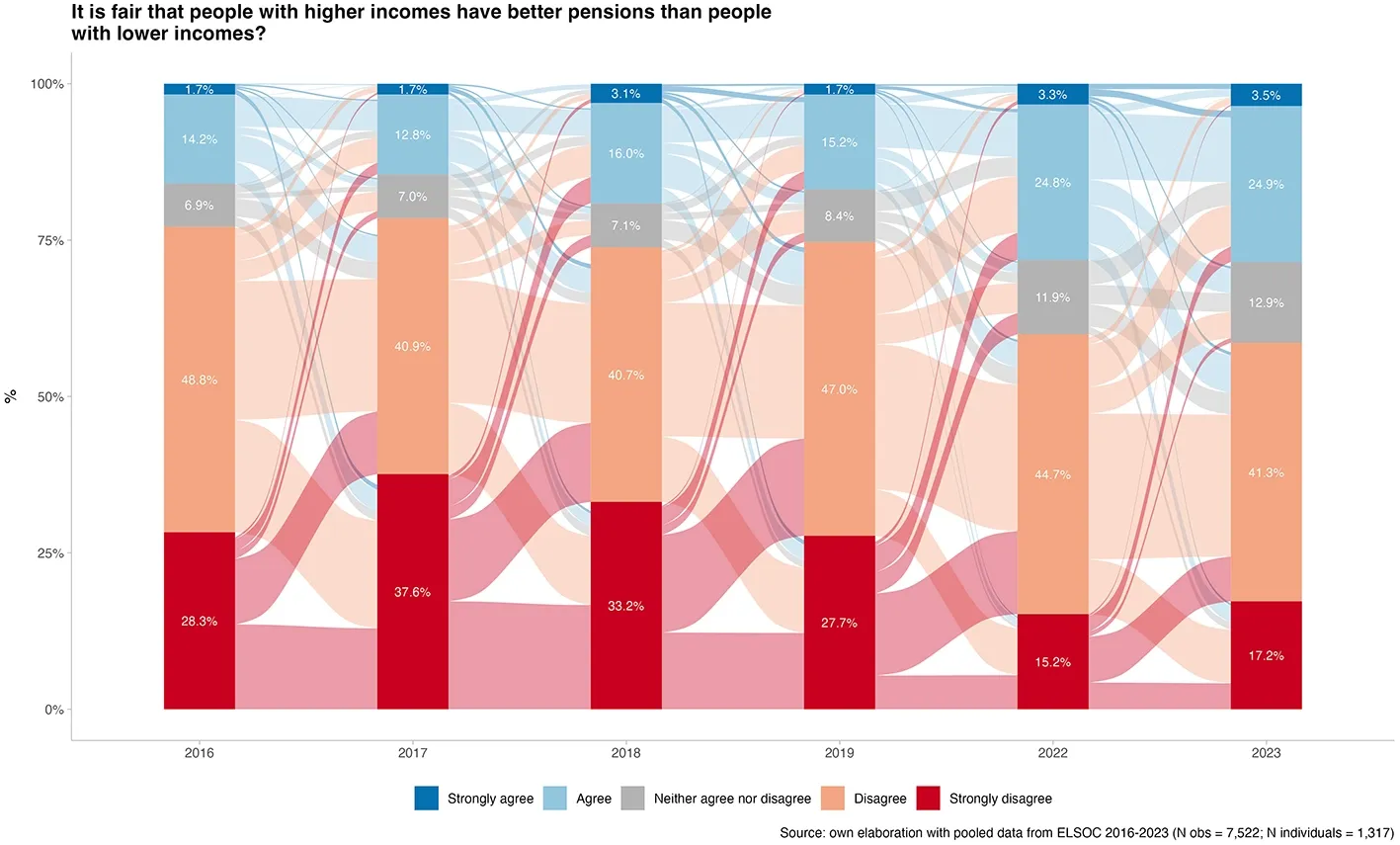
Change in the justification of inequality in healthcare, pensions and education over time (2016–2023). (a) Healthcare. (b) Pensions. (c) Education. Source: own elaboration with pooled data from ELSOC 2016–2023 (N obs = 8643; N groups = 1687).

Castillo, Laffert, Carrasco, & Iturra-Sanhueza (2025)

Market justice education

Castillo, Iturra, & Carrasco (2025)

Market justice pensions

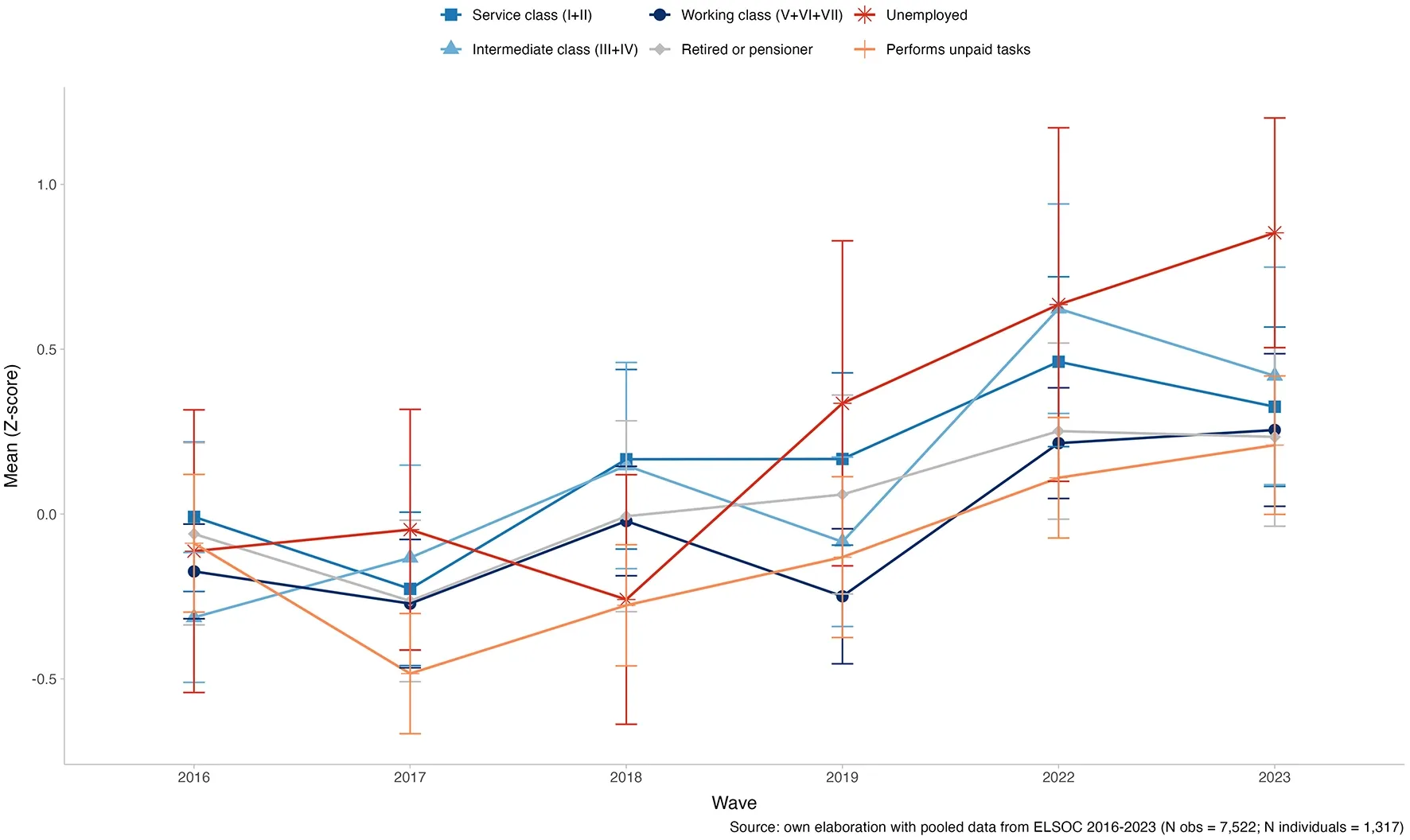
Market justice pensions & social class

Castillo, Canales-Sellés, Laffert, & Urzúa (2026)

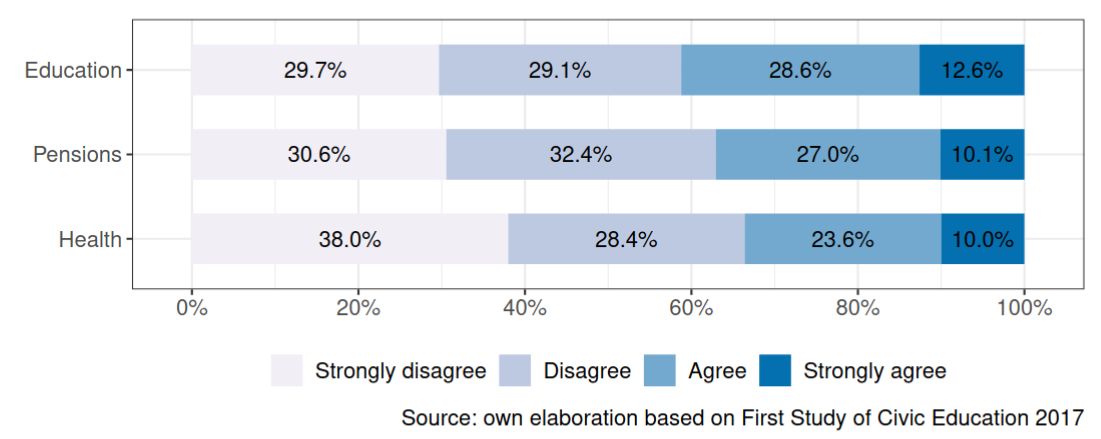
Market justice at school

Castillo, Salgado, Carrasco, & Laffert (2024)

Changes in market justice preferences

Castillo, Laffert, Carrasco, & Iturra-Sanhueza (2025)

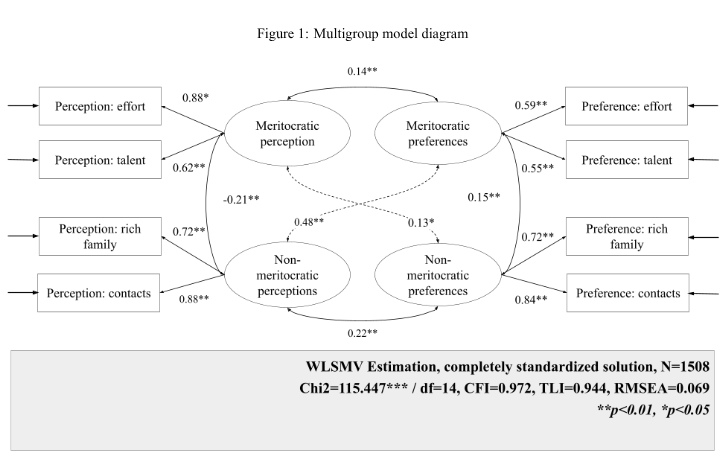
Market justice and multidimensional meritocracy

Laffert et al (2026)

Some studies

A. Multidimensional meritocracy

B. Market justice preferences & meritocracy

C. Market justice preferences & deservingness (ongoing)

Main idea

  • Estimate the relative weight of different deservingness criteria for allocating public goods in Chile

  • Study the association between meritocratic beliefs and deservingness criteria

  • Current study: conjoint-allocation survey experiment (inspired by Gilgen & Zangger (2025))

  • Stage: pre-pilot (this week)

Pilot survey

-> link to pre-pilot survey (allows translation in chrome): https://jus-mer-pre-piloto-v1.hf.space/

Attributes and levels

Attribute Criterion Profile label Levels Reference category
Need Need (CARIN/NICER) Makes ends meet with (Su hogar llega a fin de mes con:) Hardship (Dificultad)
Comfort (Holgura)
Comfort (Holgura)
Effort Effort (NICER) Studies (Estudia:) More than their peers (Más que sus compañeros)
The same as their peers (Igual que sus compañeros)
Less than their peers (Menos que sus compañeros)
Control Control (CARIN/NICER) Needs the scholarship because (Requiere la beca porque:) Applied to other scholarships but received no funding (Postuló a otras becas pero no obtuvo financiamiento)
Did not apply to other scholarships in time (No alcanzó a postular a tiempo a otras becas)
Did not apply in time (No alcanzó a postular a tiempo)
Reciprocity Reciprocity (CARIN/NICER) Outside their studies (Fuera de sus estudios:) Has done volunteer work (Ha hecho voluntariado)
Has not done volunteer work (No ha hecho voluntariado)
Attitude Attitude (CARIN) Sees the scholarship as (Ve la beca como:) Help they are grateful for (Una ayuda que agradece)
Something they deserve (Algo que se merece)
Identity Identity (CARIN/NICER) Country of birth (País de nacimiento:) Chile
Venezuela
Peru (Perú)
Chile
Sex Ascriptive (signaled by name) First name (no explicit row) Female name
Male name
Male

Note: Levels are given in English, with the ooriginal Spanish wording shown to respondents in parentheses. The factorial space comprises 2 (Need) × 3 (Effort) × 2 (Control) × 2 (Reciprocity) × 2 (Attitude) × 3 (Identity) × 2 (Sex) = 288 unique profiles. Attributes are assigned independently and uniformly at the profile level. Sex is signaled through gendered first names drawn from matched pools rather than as an explicit table row.

Next steps

Survey

  • conjoint-allocation experiment

  • expand market justice measurement

  • longitudinal design (2026-2028)

Latent class analysis of meritocracy

  • relationship with deservingness criteria

Market justice in international comparative perspective (ISSP 1999-2019)

  • health
  • education

And some final thoughts

  • So far: the extant literature focuses on political institutions as drivers of redistributive preferences (policy feedback in welfare regimes)

  • Instead:

    • Focus on markets as political institutions
    • Focus on market preferences
    • Focus on deservingness criteria (including meritocratic beliefs)
  • We need:

    • Development of measurement instruments (valid estimands)
    • Instead of discovering “paradoxes”, better theoretical background - as for instance Mau et al.(2024) Triggerpunkte
    • Including larger variation in contextual inequality in comparative research

Thanks, comments most welcome!

Project website: https://jus-mer.com

Project Github: https://github.com/jus-mer


Market Justice and Deservingness of Social Welfare

FONDECYT Grant 2025-2029


Juan Carlos Castillo

Tomás Urzúa

Department of Sociology, University of Chile


August 2026 - University of Chile

References

Busemeyer, M. (2015). Skills and inequality: Partisan politics and the political economy of education reforms in western welfare states. Cambridge: Cambridge University Press. https://doi.org/10.1017/CBO9781107477650
Busemeyer, M., & Iversen, T. (2020). The Welfare State with Private Alternatives: The Transformation of Popular Support for Social Insurance. The Journal of Politics, 82(2), 671–686. https://doi.org/10.1086/706980
Campbell, J. L. (2020). Institutional Change and Globalization. Princeton University Press. https://doi.org/10.2307/j.ctv131bw68
Castillo, J. C., Canales-Sellés, R., Laffert, A., & Urzúa, T. (2026). Justification trajectories for pension inequality in Chile (2016–2023): The role of social class and beliefs in meritocracy. Frontiers in Sociology, 11, 1771856. https://doi.org/10.3389/fsoc.2026.1771856
Castillo, J. C., Iturra, J., & Carrasco, K. (2025). Changes in the Justification of Educational Inequalities: The Role of Perceptions of Inequality and Meritocracy During the COVID Pandemic. Social Justice Research, 38(3), 240–263. https://doi.org/10.1007/s11211-025-00458-0
Castillo, J. C., Iturra, J., Maldonado, L., Atria, J., & Meneses, F. (2023). A Multidimensional Approach for Measuring Meritocratic Beliefs: Advantages, Limitations and Alternatives to the ISSP Social Inequality Survey. International Journal of Sociology, 53(6), 448–472. https://doi.org/10.1080/00207659.2023.2274712
Castillo, J. C., Laffert, A., Carrasco, K., & Iturra-Sanhueza, J. (2025). Perceptions of inequality and meritocracy: Their interplay in shaping preferences for market justice in Chile (2016–2023). Frontiers in Sociology, 10, 1634219. https://doi.org/10.3389/fsoc.2025.1634219
Castillo, J. C., Salgado, M., Carrasco, K., & Laffert, A. (2024). The Socialization of Meritocracy and Market Justice Preferences at School. Societies, 14(11), 214. https://doi.org/10.3390/soc14110214
Fernandez, J. J., & Jaime-Castillo, A. M. (2013). Positive or Negative Policy Feedbacks? Explaining Popular Attitudes Towards Pragmatic Pension Policy Reforms. European Sociological Review, 29(4), 803–815. https://doi.org/10.1093/esr/jcs059
Ferre, J. C. (2023). Welfare regimes in twenty-first-century Latin America. Journal of International and Comparative Social Policy, 39(2), 101–127. https://doi.org/10.1017/ics.2023.16
Flores, I., Sanhueza, C., Atria, J., & Mayer, R. (2020). Top Incomes in Chile: A Historical Perspective on Income Inequality, 1964–2017. Review of Income and Wealth, 66(4), 850–874. https://doi.org/10.1111/roiw.12441
Gilgen, S., & Zangger, C. (2025). From principles to practice: Distributive justice and the role of perceived inequality in reward allocation. Frontiers in Sociology, 10, 1660806. https://doi.org/10.3389/fsoc.2025.1660806
Gingrich, J. R. (2011). Making Markets in the Welfare State: The Politics of Varying Market Reforms (1st ed.). Cambridge University Press. https://doi.org/10.1017/CBO9780511791529
Immergut, E. M., & Schneider, S. M. (2020). Is it unfair for the affluent to be able to purchase “better” healthcare? Existential standards and institutional norms in healthcare attitudes across 28 countries. Social Science & Medicine, 267, 113146. https://doi.org/10.1016/j.socscimed.2020.113146
Kluegel, J., Mason, D., & Wegener, B. (1999). The Legitimation of Capitalism in the Postcommunist Transition: Public Opinion about Market Justice, 1991-1996. European Sociological Review, 15(3), 33. Retrieved from https://www.jstor.org/stable/522731
Knotz, C. M., Gandenberger, M. K., Fossati, F., & Bonoli, G. (2022). A Recast Framework for Welfare Deservingness Perceptions. Social Indicators Research, 159(3), 927–943. https://doi.org/10.1007/s11205-021-02774-9
Koos, S., & Sachweh, P. (2019). The moral economies of market societies: Popular attitudes towards market competition, redistribution and reciprocity in comparative perspective. Socio-Economic Review, 17(4), 793–821. https://doi.org/10.1093/ser/mwx045
Laffert, A., Castillo, J. C., Canales, R., Urzúa, T., & Carrasco, K. (2026). Stability and comparability of meritocratic beliefs in school-age students: A measurement invariance approach across time and cohorts. SocArXiv. https://doi.org/10.31235/osf.io/gvbqw_v1
Lane, R. E. (1986). Market Justice, Political Justice. American Political Science Review, 80(2), 383–402. https://doi.org/10.2307/1958264
Lee, J.-S., & Stacey, M. (2024). Fairness perceptions of educational inequality: The effects of self-interest and neoliberal orientations. The Australian Educational Researcher, 51(4), 1215–1237. https://doi.org/10.1007/s13384-023-00636-6
Lindh, A. (2015). Public Opinion against Markets? Attitudes towards Market Distribution of Social Services – A Comparison of 17 Countries. Social Policy & Administration, 49(7), 887–910. https://doi.org/10.1111/spol.12105
López-Roldán, P., & Fachelli, S. (Eds.). (2021). Towards a Comparative Analysis of Social Inequalities between Europe and Latin America. Cham: Springer International Publishing. https://doi.org/10.1007/978-3-030-48442-2
Madariaga, A. (2020). The three pillars of neoliberalism: Chile’s economic policy trajectory in comparative perspective. Contemporary Politics, 26(3), 308–329. https://doi.org/10.1080/13569775.2020.1735021
Mau, S. (2015). Inequality, Marketization and the Majority Class: Why Did the European Middle Classes Accept Neo-Liberalism? London: Palgrave Macmillan UK.
Meuleman, B., Roosma, F., & Abts, K. (2020). Welfare deservingness opinions from heuristic to measurable concept: The CARIN deservingness principles scale. Social Science Research, 85, 102352. https://doi.org/10.1016/j.ssresearch.2019.102352
Mijs, J. J. B. (2019). The paradox of inequality: Income inequality and belief in meritocracy go hand in hand. Socio-Economic Review. https://doi.org/10.1093/ser/mwy051
Oorschot, W. V. (2000). Who should get what, and why? On deservingness criteria and the conditionality of solidarity among the public. Policy & Politics, 28(1), 33–48. https://doi.org/10.1332/0305573002500811
Sandel, M. J. (2020). The Tyranny of Merit: What’s Become of the Common Good? Penguin UK.
Streeck, W. (2016). How will capitalism end? Essays on a failing system. London New York, NY: Verso.
Superintendencia, de P. (2025). Cuadros de afiliación a AFP.
Svallfors, S. (Ed.). (2007). The Political Sociology of the Welfare State: Institutions, Social Cleavages, and Orientations (1st ed.). Stanford University Press. https://doi.org/10.2307/j.ctvr0qv0q
Torche, F. (2014). Intergenerational Mobility and Inequality: The Latin American Case. Annual Review of Sociology, 40(1), 619–642. https://doi.org/10.1146/annurev-soc-071811-145521
Young, M. (1958). The rise of the meritocracy. New Brunswick, N.J., U.S.A: Transaction Publishers.