
Conceptualizing and measuring meritocracy

Background, developments and extensions


Juan Carlos Castillo
Tomás Urzúa

Department of Sociology, University of Chile


Online presentation for the EDUMERIT ERC Project
Tallin University
September 2026

1. Background

Project grant 1 (2016-2020)


The moral economy of inequality and redistributive preferences (2016-2020) - FONDECYT N°1160161

  • Analyze the relationship between beliefs in meritocracy and redistributive preferences from a moral economy perspective, considering the institutional context in Chile and international comparative perspective.

Project grant2 (2021-2024)


EDUMER: Meritocracy in Schools - Moral Foundations of the Educational Market and its Implications for Civic Education in Chile (2021-2024) - FONDECYT N°1210847

  • Analyze the socialization of meritocratic beliefs in schools, their evolution over time, and their implications for civic education and social cohesion.

Project grant 3 (2025-2029)

JUSMER: Market Justice and Deservingness of Social Welfare (2025-2029) - FONDECYT N°1250518

  • Objective: Analyze market justice preferences in Chile, their evolution over time, and their relation to welfare deservingness

Selected articles

Peer reviewed

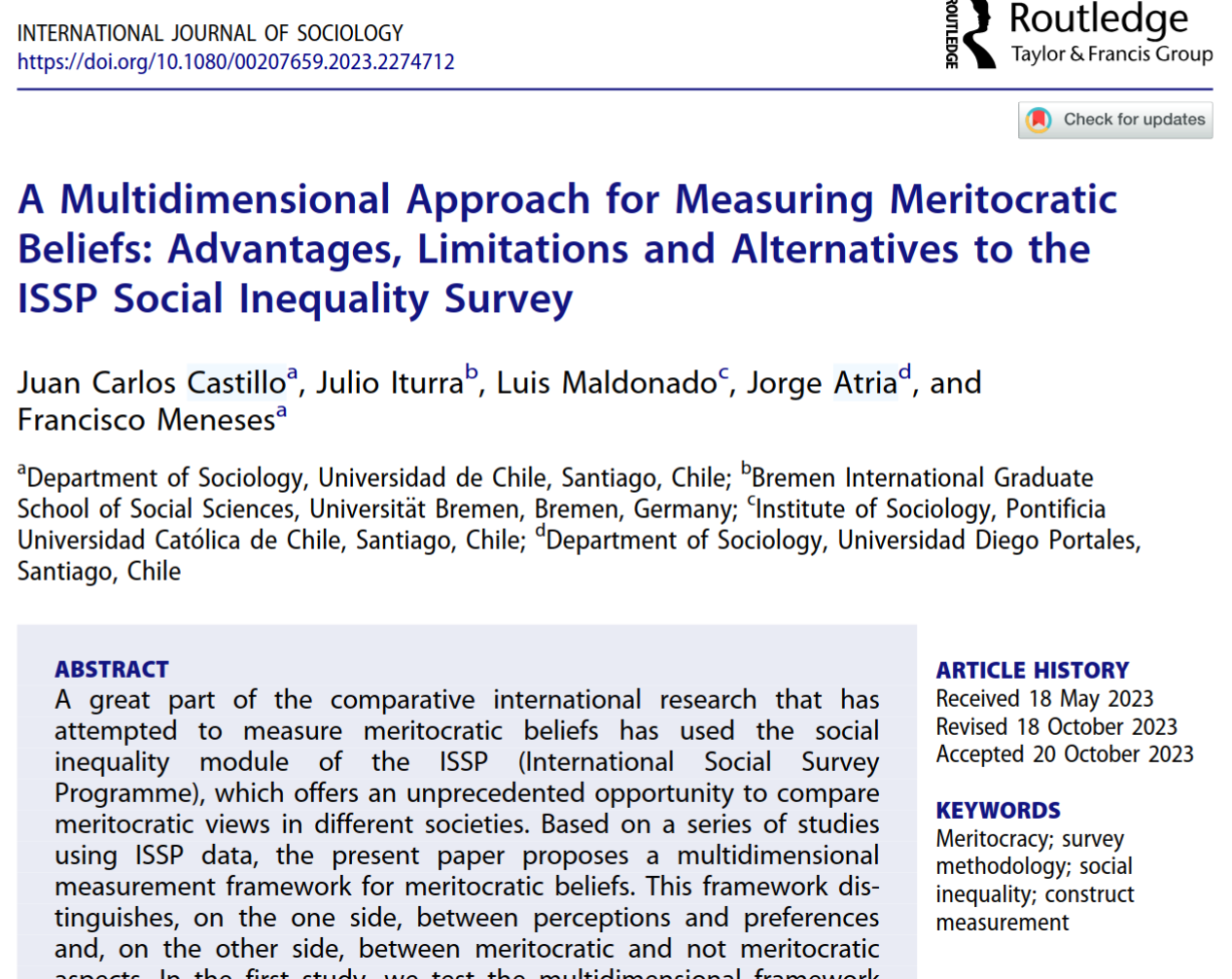
  • Castillo, J. C., Iturra, J., Maldonado, L., Atria, J., & Meneses, F. (2023). A Multidimensional Approach for Measuring Meritocratic Beliefs: Advantages, Limitations and Alternatives to the ISSP Social Inequality Survey. International Journal of Sociology, 53(6), 448–472. https://doi.org/10.1080/00207659.2023.2241875

  • Castillo, J. C., Salgado, M., Carrasco, K., & Laffert, A. (2024). The Socialization of Meritocracy and Market Justice Preferences at School. Societies, 14(11), 214. doi.org/10.3390/soc14110214

  • Castillo, J. C., Laffert, A., Carrasco, K., & Iturra-Sanhueza, J. (2025). Perceptions of inequality and meritocracy: their interplay in shaping preferences for market justice in Chile (2016–2023). Frontiers in Sociology, 10, 1634219. https://doi.org/10.3389/fsoc.2025.1634219

  • Castillo, Juan Carlos; Iturra, Julio & Carrasco, Kevin (2025). Changes in the Justification of Educational Inequalities: The Role of Perceptions of Inequality and Meritocracy During the COVID Pandemic. Social Justice Research, 38(3) 240–263 https://doi.org/10.1007/s11211-025-00458-0

  • Castillo, J. C., Canales Sellés, R., Laffert, A., & Urzúa, T. (2026). Justification trajectories for pension inequality in Chile (2016–2023): the role of social class and beliefs in meritocracy. Frontiers in Sociology, 11, 1771856. https://doi.org/10.3389/fsoc.2026.1771856

Forthcoming

  • Stability and comparability of meritocratic beliefs in school-age students: A measurement invariance approach across time and cohorts. Andreas Laffert, Juan Carlos Castillo, René Canales, Tomás Urzúa & Kevin Carrasco. Submited.

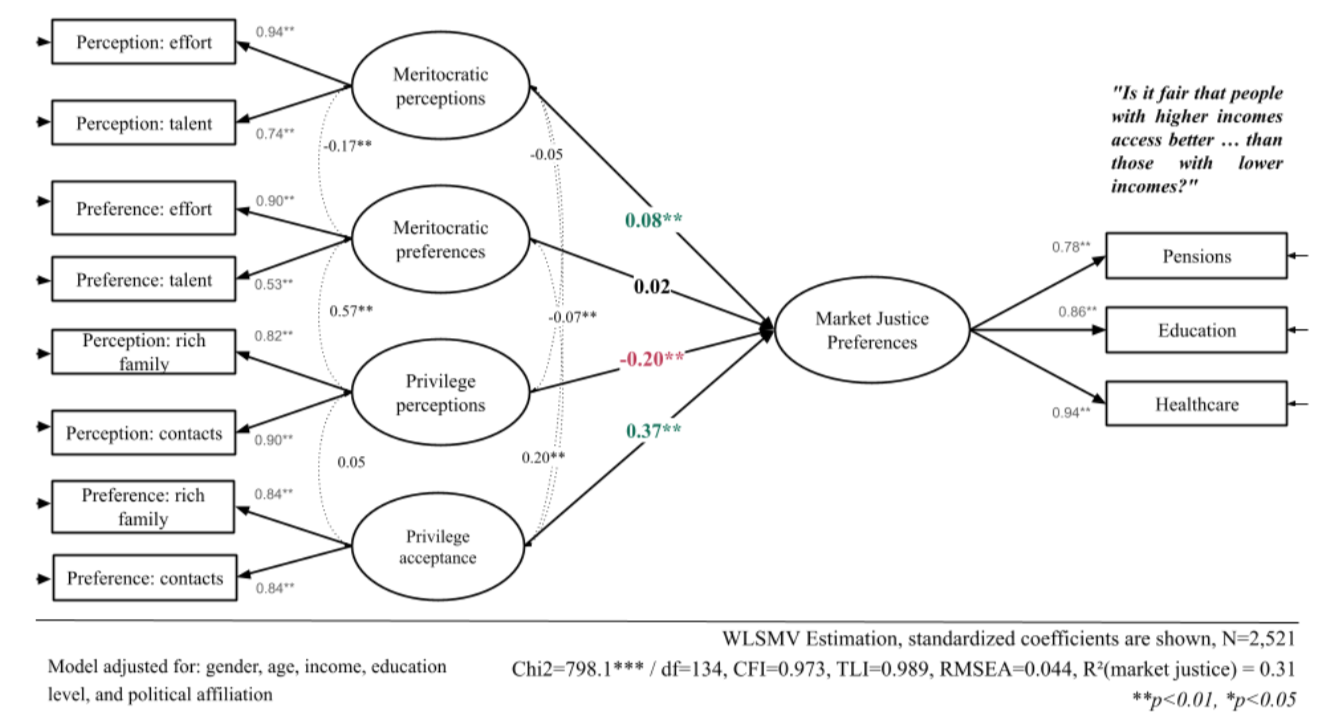
  • Market justice and meritocracy: A structural equation modeling approach. Andreas Laffert, Tomás Urzúa, Juan Carlos Castillo & René Canales.

  • Inequality and deservingness in higher education in Chile. A conjoint survey experiment. Juan Carlos Castillo, Andreas Laffert, René Canales & Tomás Urzúa.

  • Objective and subjective status: their interplay with market justice preferences in a comparative perspective. Juan Carlos Castillo, Tomás Urzúa

  • Market justice preferences in education: The role of meritocratic beliefs in the chilean context. Tomás Urzúa, Juan Carlos Castillo

2. Developments

Black box of meritocratic beliefs

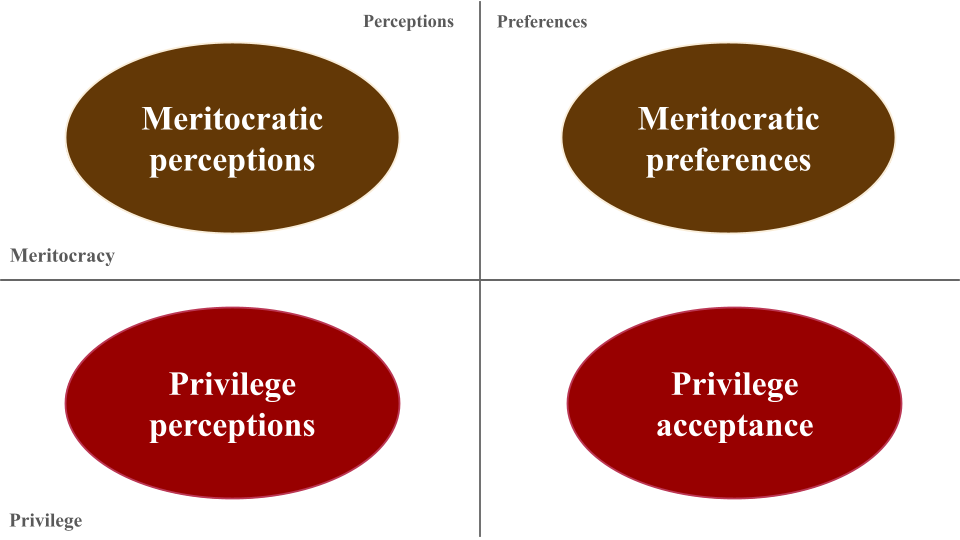
  • Merit: only effort? -> add talent

  • Beliefs? -> perceptions and preferences

  • Non-meritocratic elements? -> add privilege

  • Measurement error -> latent variable modeling

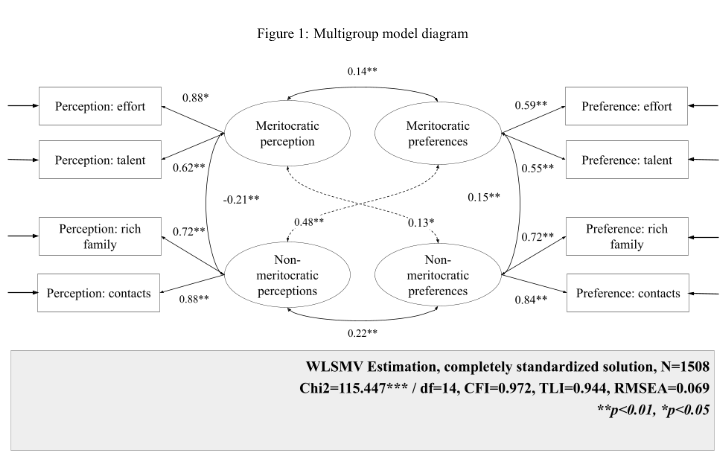
Multidimensional framework of meritocracy
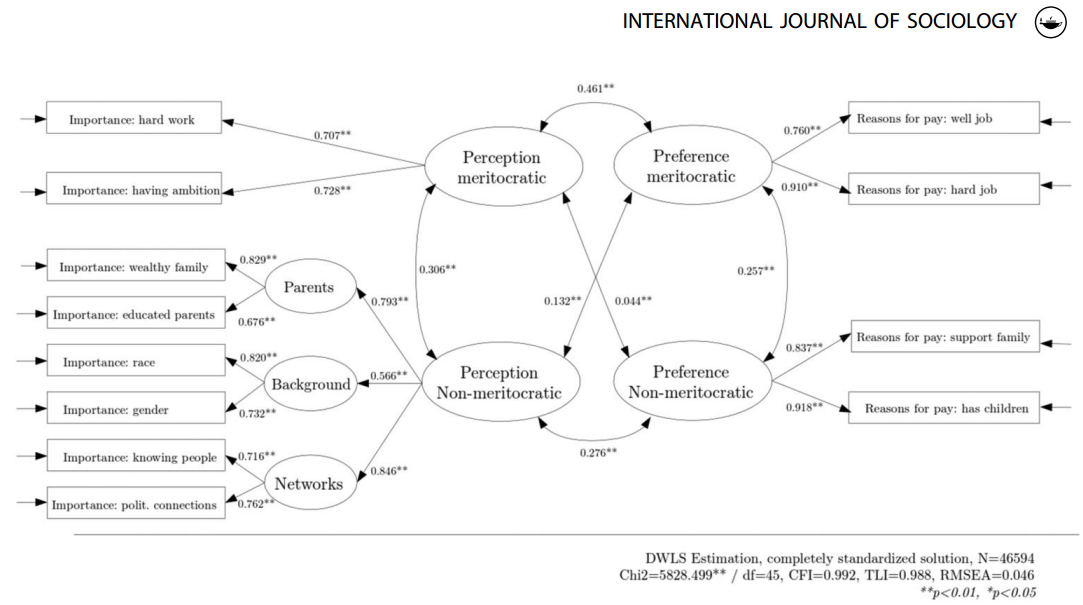
Castillo et al. (2023) conceptual model

Multidimensional framework of meritocracy
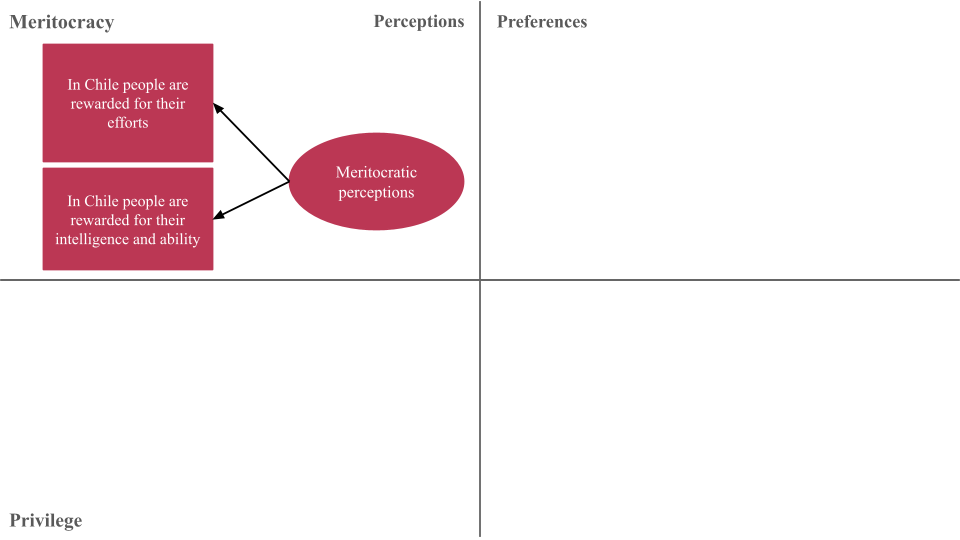
Castillo et al. (2023) conceptual model

Multidimensional framework of meritocracy
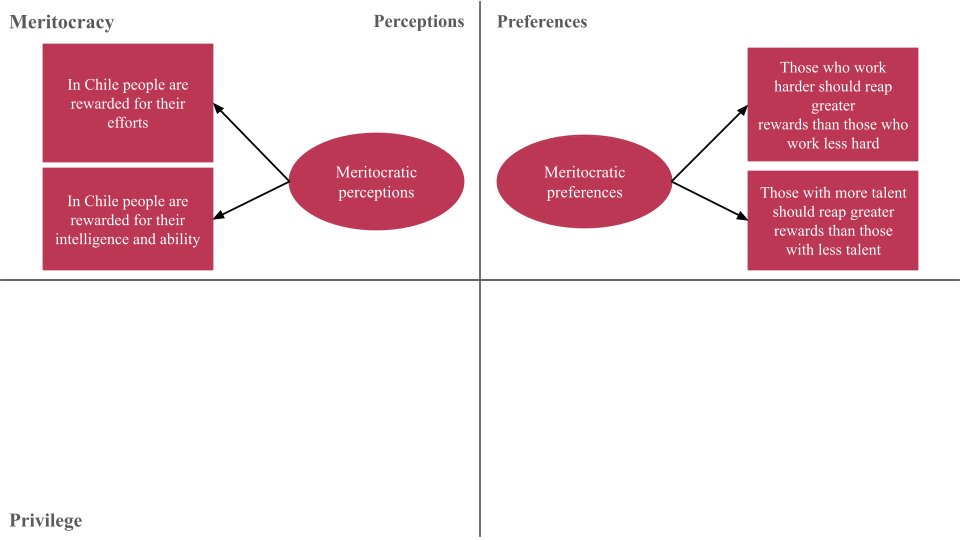
Castillo et al. (2023) conceptual model

Multidimensional framework of meritocracy
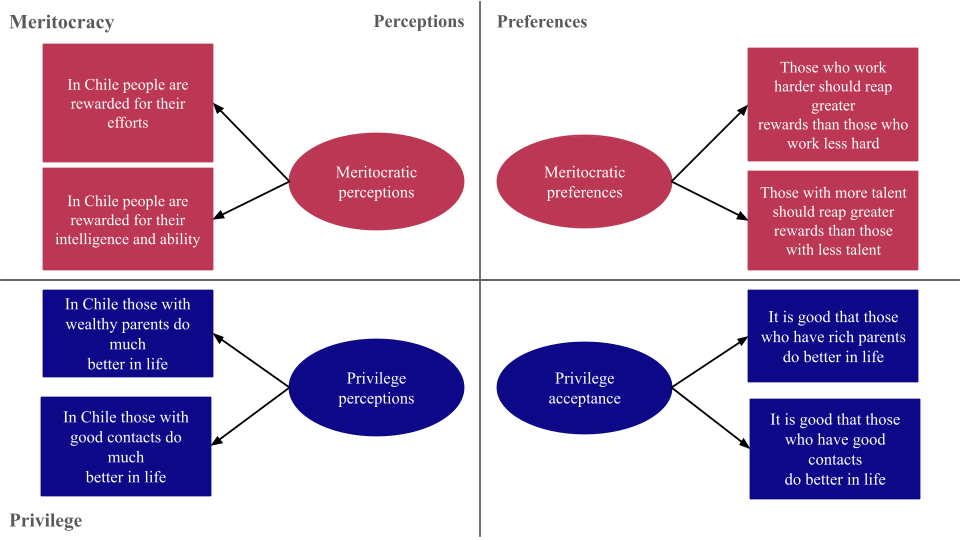
Castillo et al. (2023) conceptual model

Multidimensional framework of meritocracy
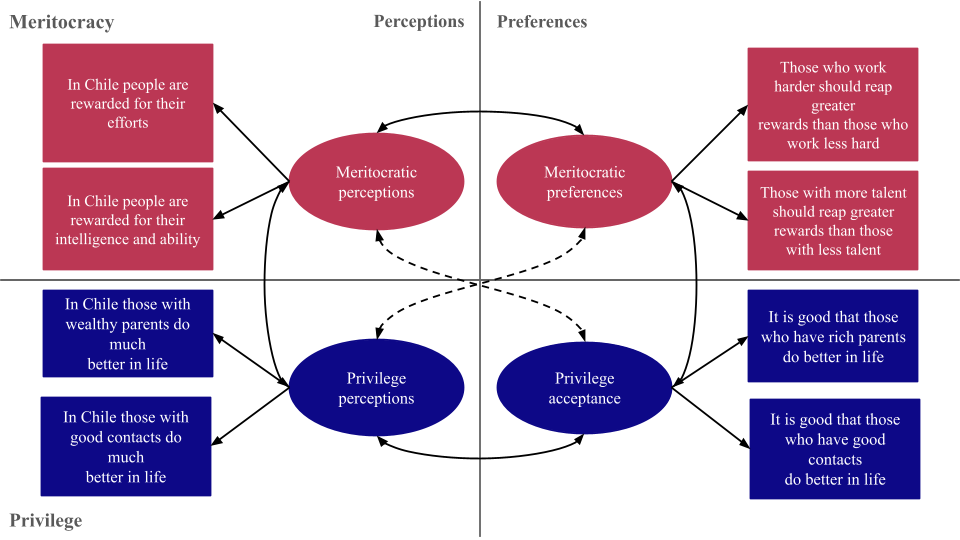
Castillo et al. (2023) conceptual model

Castillo, J. C., Iturra, J., Maldonado, L., Atria, J., & Meneses, F. (2023). A Multidimensional Approach for Measuring Meritocratic Beliefs: Advantages, Limitations and Alternatives to the ISSP Social Inequality Survey. International Journal of Sociology, 53(6), 448–472. https://doi.org/10.1080/00207659.2023.2274712
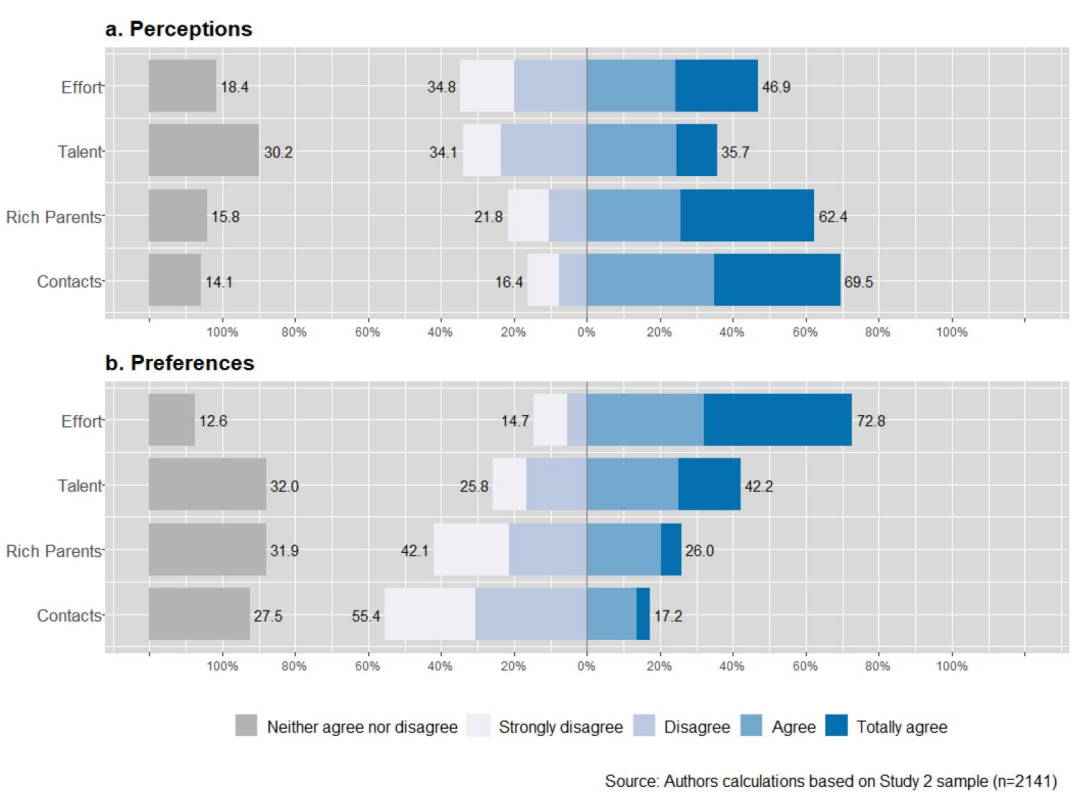
Castillo, J. C., Iturra, J., Maldonado, L., Atria, J., & Meneses, F. (2023). A Multidimensional Approach for Measuring Meritocratic Beliefs: Advantages, Limitations and Alternatives to the ISSP Social Inequality Survey. International Journal of Sociology, 53(6), 448–472. https://doi.org/10.1080/00207659.2023.2274712
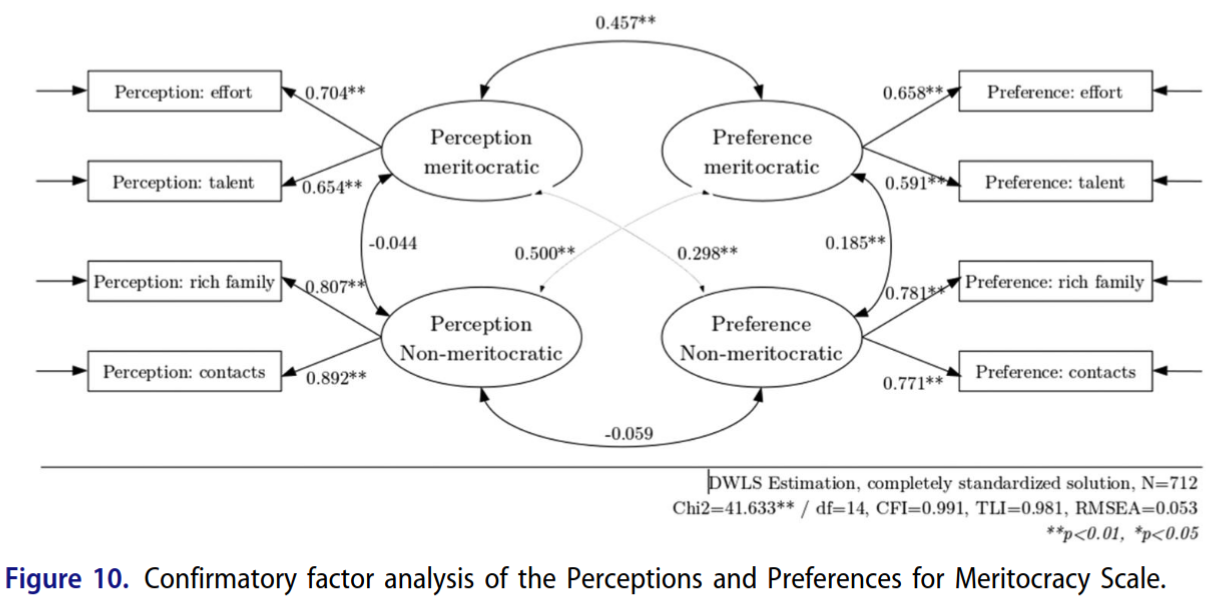
Castillo, J. C., Iturra, J., Maldonado, L., Atria, J., & Meneses, F. (2023). A Multidimensional Approach for Measuring Meritocratic Beliefs: Advantages, Limitations and Alternatives to the ISSP Social Inequality Survey. International Journal of Sociology, 53(6), 448–472. https://doi.org/10.1080/00207659.2023.2274712
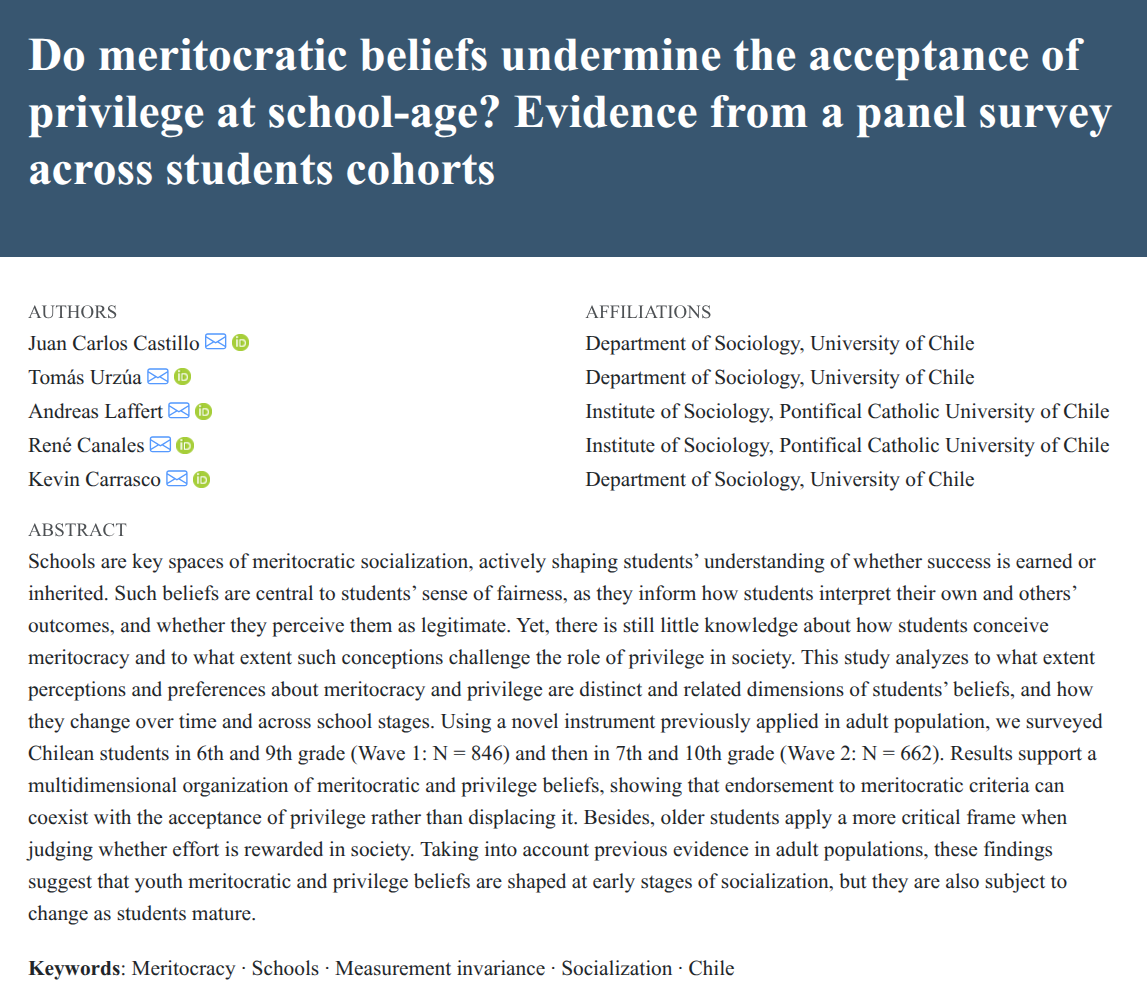
Participants and procedure

  • Education and Meritocracy Panel Survey (EDUMER) in its 2023 and 2024 waves for students.

  • CAWI survey application to elementary and high school students from 9 schools in the Metropolitan Region and Valparaíso, Chile.

  • First wave (N = 846) composed of 386 girls, 421 boys, 39 who identify as other; \(M_{age}\) = 13.4, \(SD_{age}\) = 1.6

  • Second wave (N = 662) composed of 303 girls, 338 boys, 21 who identify as other; \(M_{age}\) = 14.4, \(SD_{age}\) = 1.6

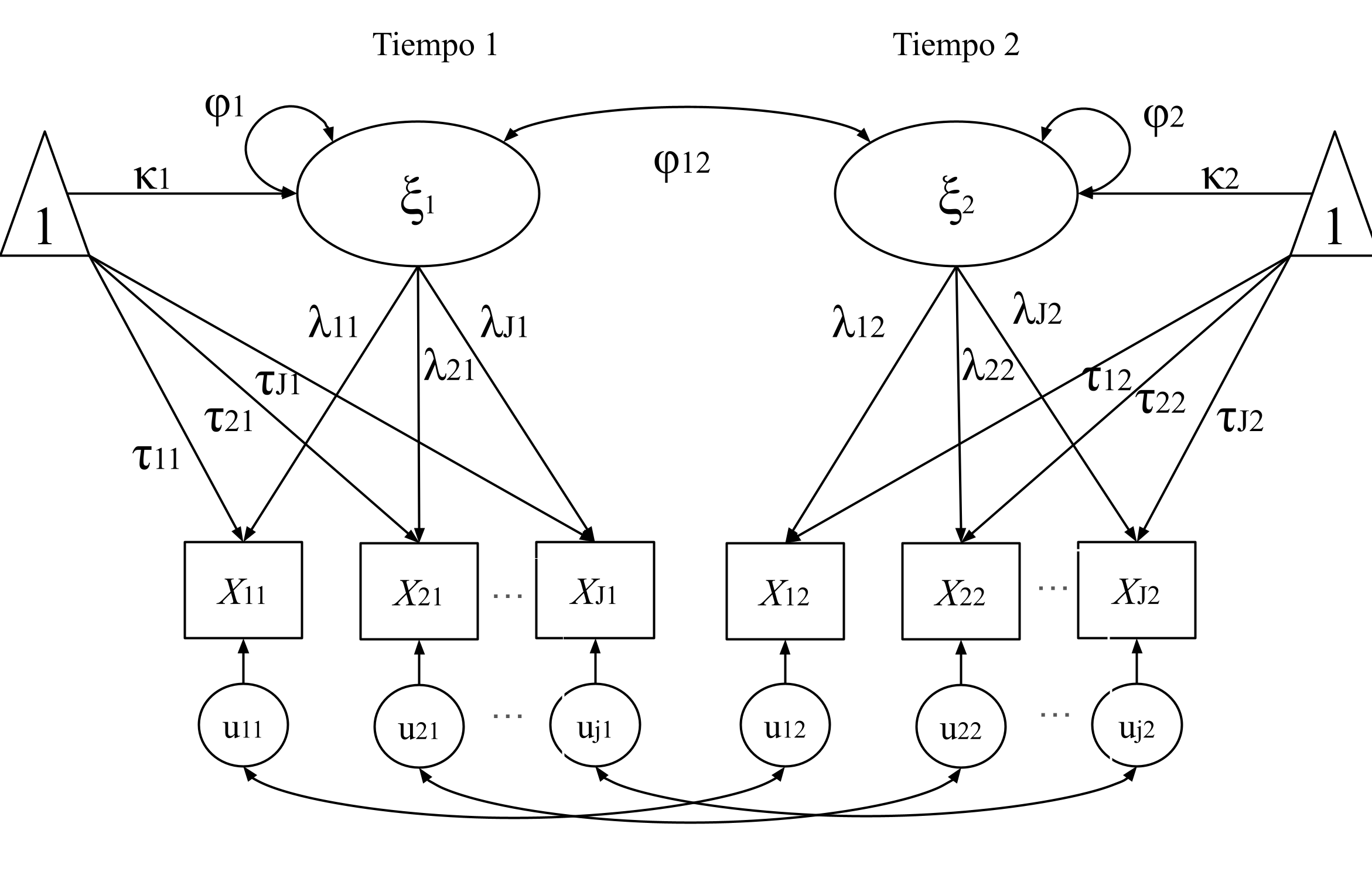
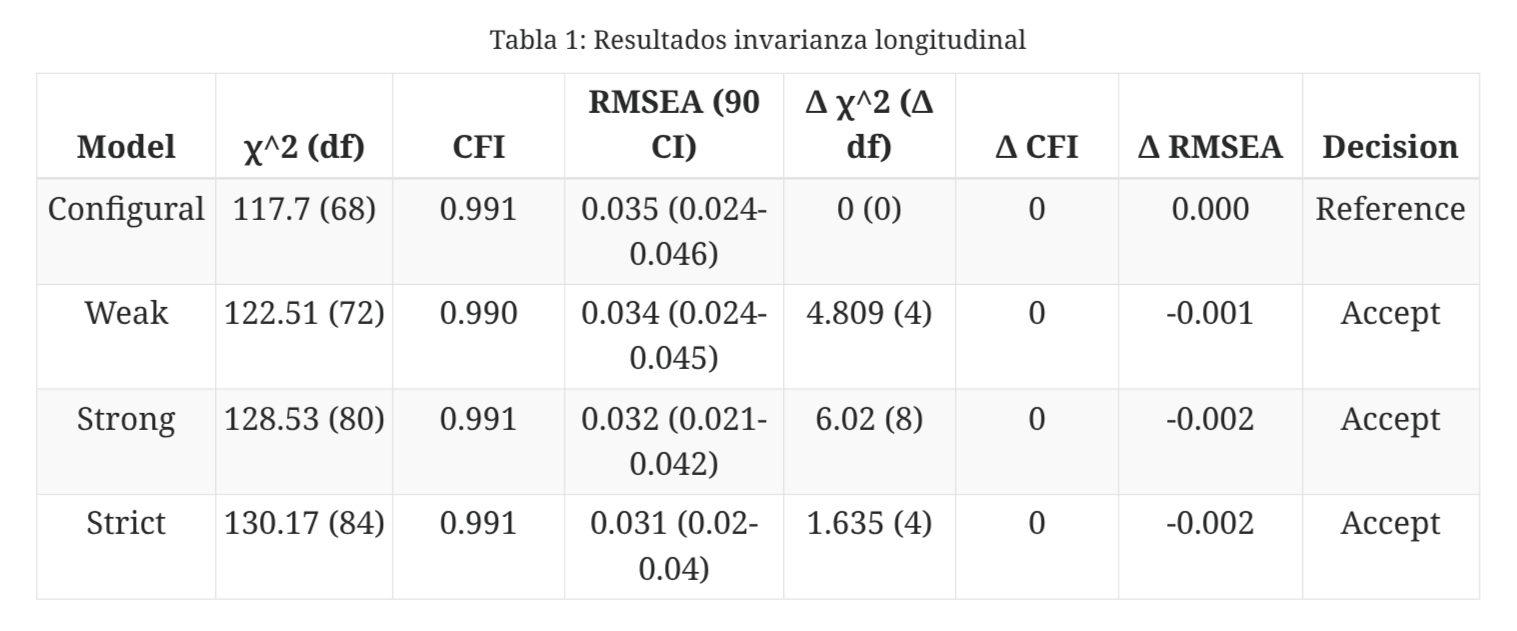
Longitudinal invariance

Longitudinal invariance
Data

  • EDUMERCO: Online survey (CAWI), fielded in 2025, with adult respondents from the Metropolitan Region of Chile

  • Non-probability sample with quota-based design
    → approximating population parameters by age, gender, education, and socioeconomic status

  • Total sample: N = 3,470

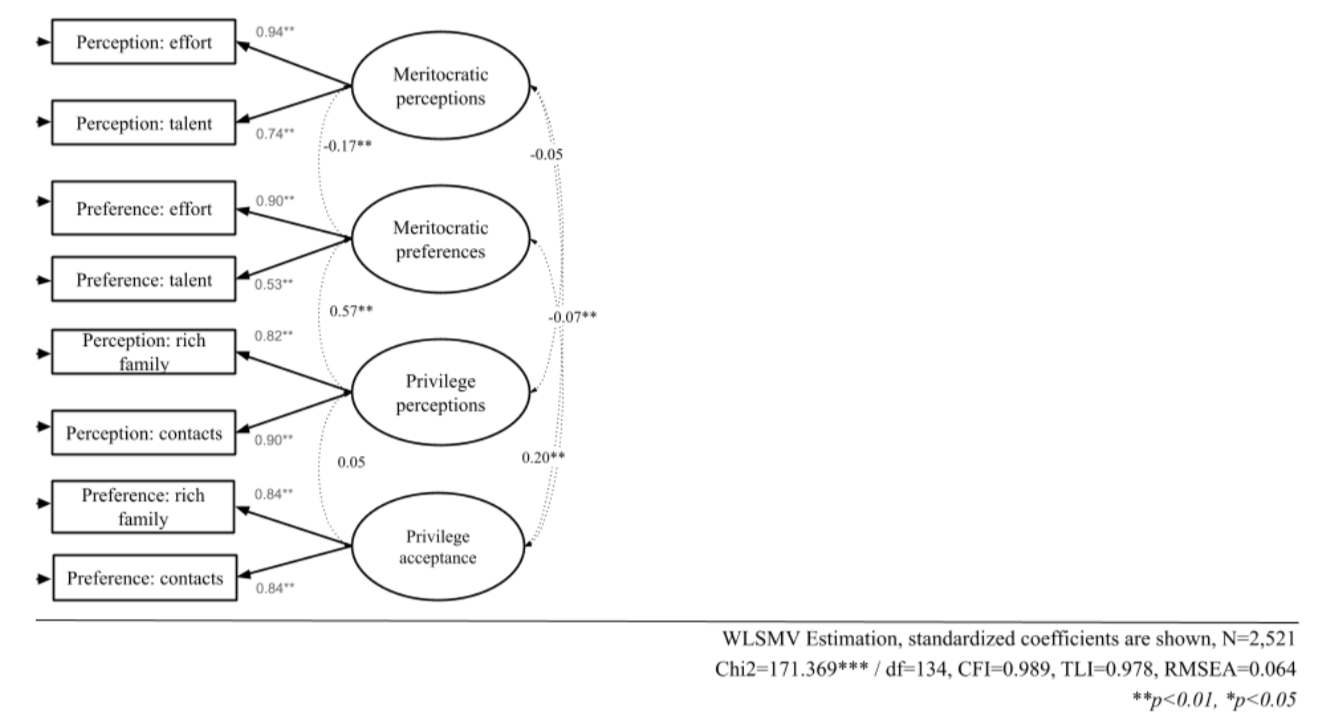
CFA

Confirmatory Factor Analysis

SEM Model

Structural Ecuation Model

3. Current extensions

  • Latent Class Analysis

  • Conjoint survey experiment

Latent Class Analysis

LCA estimation

  • Parameters:

    • \(P_{jk}\): conditional probability of response \(j\) given class \(k\)
    • \(\pi_k\): estimated class proportion for class \(k\)
  • Model selection based on BIC, AIC, and entropy


Collins, L., & Lanza, S. (2010). Latent class and latent transition analysis: With applications in the social behavioral, and health sciences. London: Wiley.

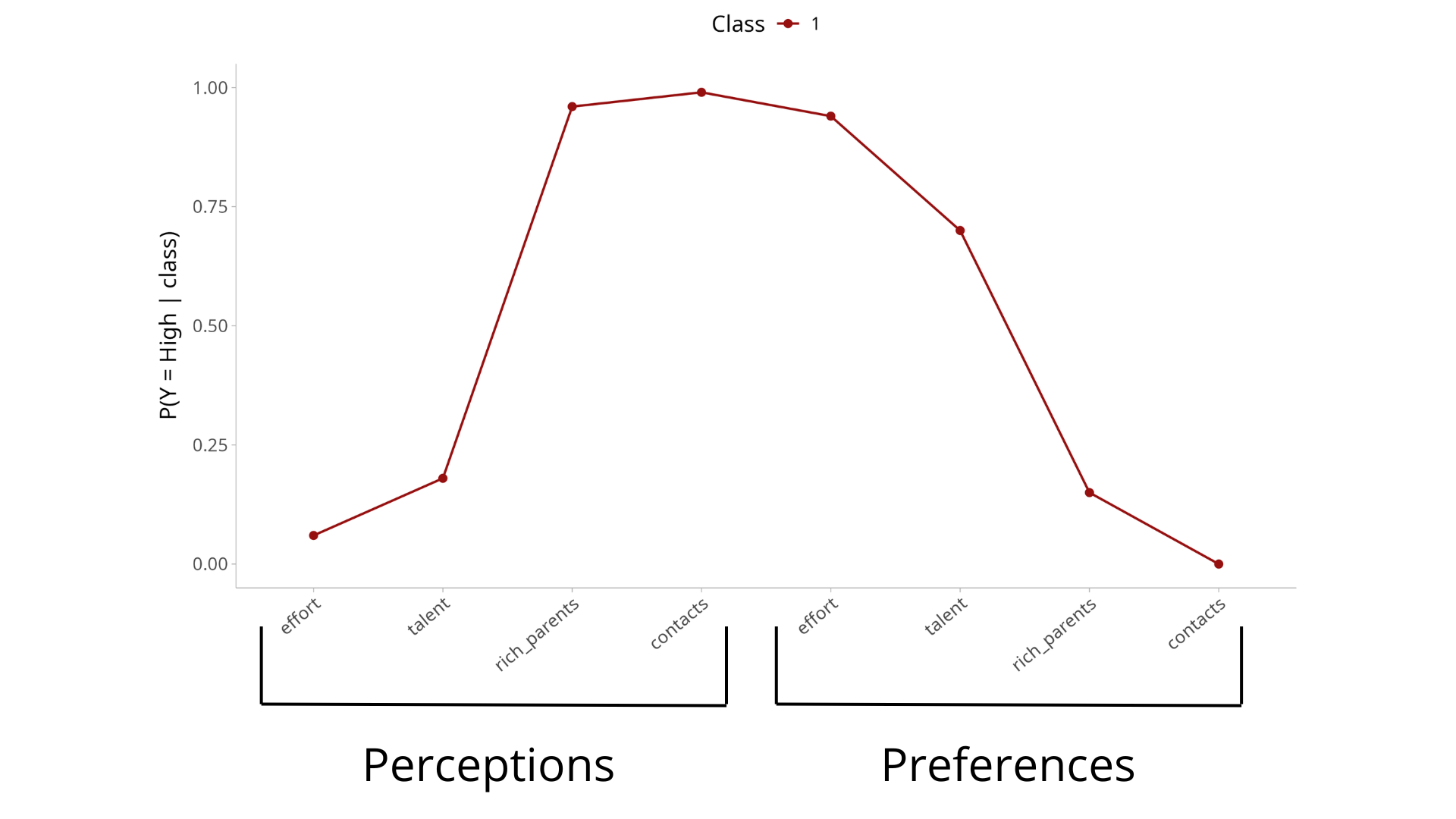
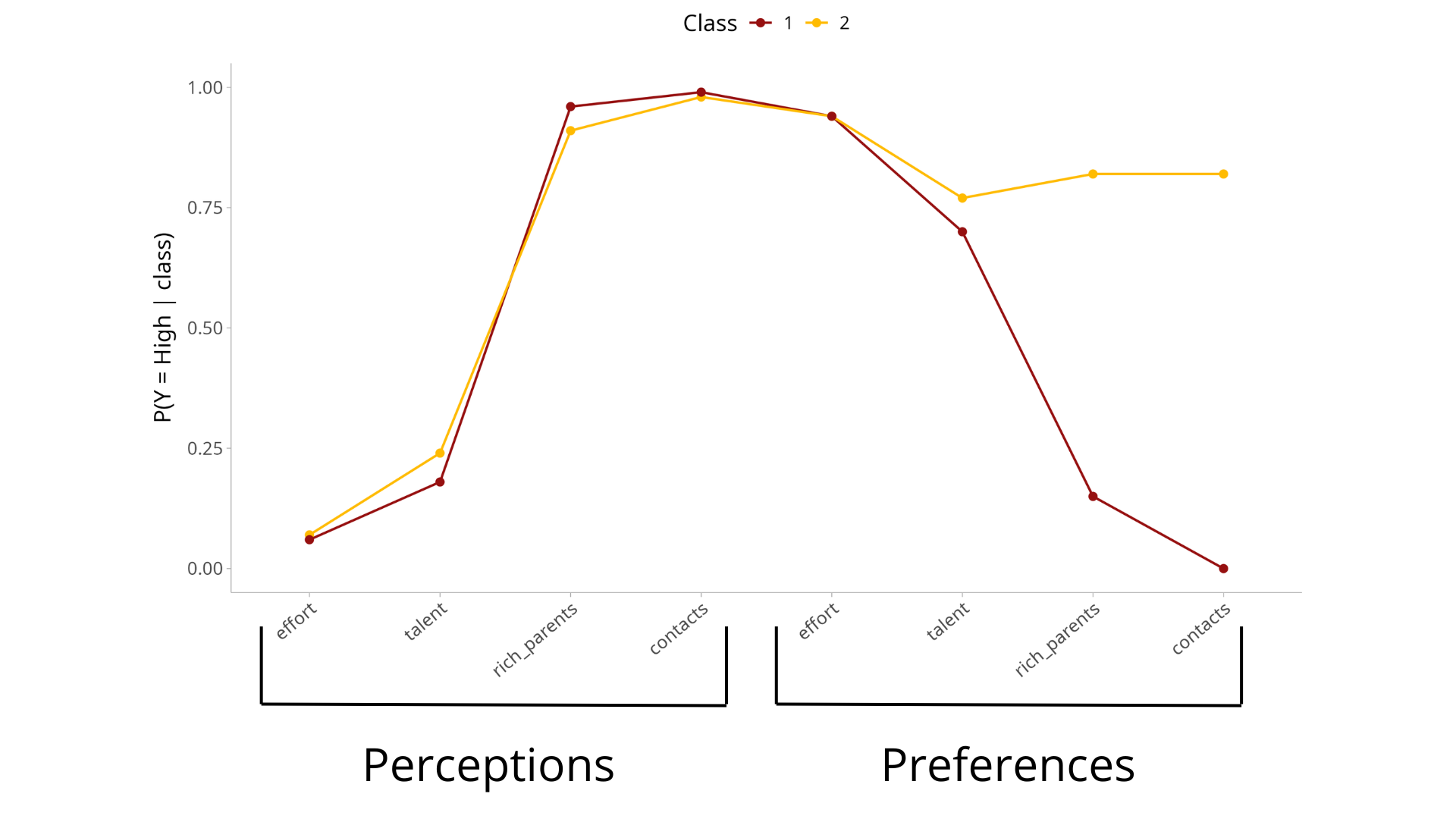
Figure 1: Conditional probabilities of the 4-class solution. EDUMERCO data (N = 2470)
  • Class 1 Critical Meritocrats (36.2%)

Urzúa, T., Castillo, J. C. (2026). Identifying Patterns of Beliefs Based on Merit and Privilege: A Latent Class Analysis Approach. Work in progress

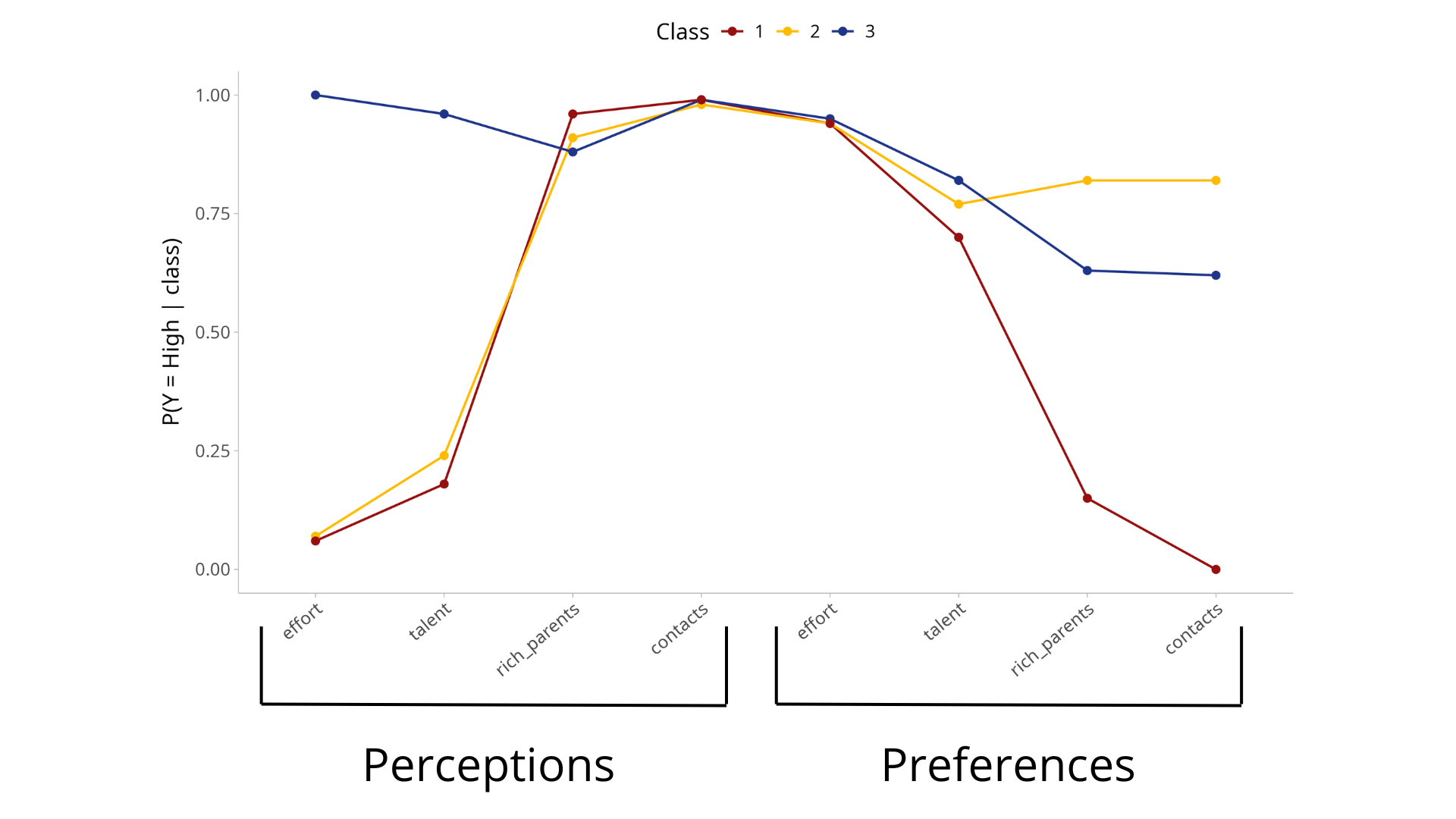
Figure 2: Conditional probabilities of the 4-class solution. EDUMERCO data (N = 2470)
  • Class 2: Privilege advocates (36.3%)

Urzúa, T., Castillo, J. C. (2026). Identifying Patterns of Beliefs Based on Merit and Privilege: A Latent Class Analysis Approach. Work in progress

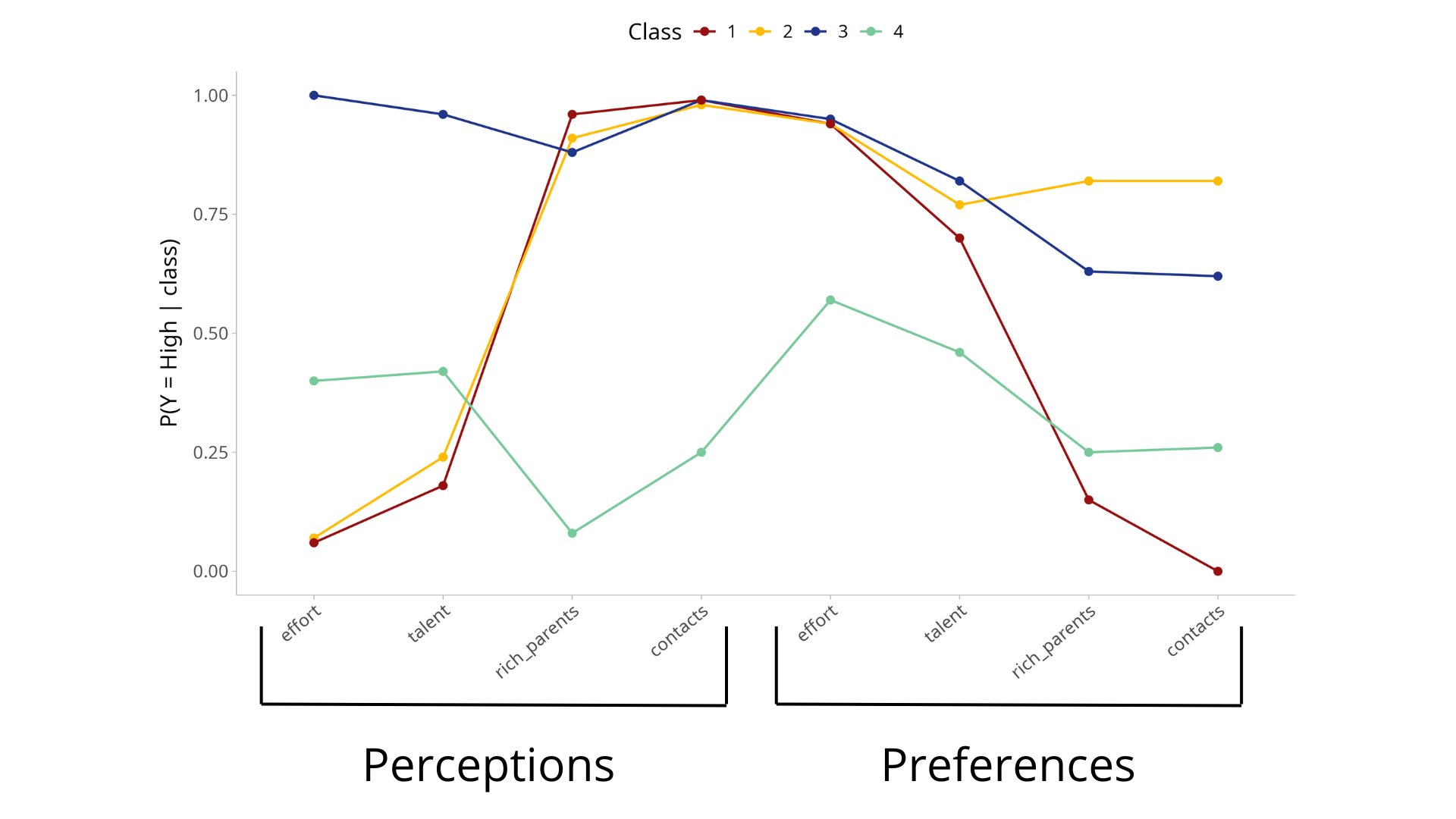
Figure 3: Conditional probabilities of the 4-class solution. EDUMERCO data (N = 2470)
  • Class 3 Universal rewards (20.7%)

Urzúa, T., Castillo, J. C. (2026). Identifying Patterns of Beliefs Based on Merit and Privilege: A Latent Class Analysis Approach. Work in progress

Figure 4: Conditional probabilities of the 4-class solution. EDUMERCO data (N = 2470)
  • Class 4 Against privilege (6.8%)

Urzúa, T., Castillo, J. C. (2026). Identifying Patterns of Beliefs Based on Merit and Privilege: A Latent Class Analysis Approach. Work in progress

Conjoint survey experiment

  • Estimate the relative weight of different deservingness criteria (Knotz et al 2022; Meuleman et al 2020; van Oorschot, 2000) for allocating public goods in Chile

  • Study the association between meritocratic beliefs and deservingness criteria

  • Current study: conjoint-allocation survey experiment (inspired by Gilgen & Zangger, 2025) to be fielded this year 2026. Programmed in surveydown (R).


Gilgen, S., & Zangger, C. (2025). From principles to practice: Distributive justice and the role of perceived inequality in reward allocation. Frontiers in Sociology, 10, 1660806. https://doi.org/10.3389/fsoc.2025.1660806

Knotz, C. M., Gandenberger, M. K., Fossati, F., & Bonoli, G. (2022). A Recast Framework for Welfare Deservingness Perceptions. Social Indicators Research, 159(3), 927–943. https://doi.org/10.1007/s11205-021-02774-9

Meuleman, B., Roosma, F., & Abts, K. (2020). Welfare deservingness opinions from heuristic to measurable concept: The CARIN deservingness principles scale. Social Science Research, 85, 102352. https://doi.org/10.1016/j.ssresearch.2019.102352

Oorschot, W. V. (2000). Who should get what, and why? On deservingness criteria and the conditionality of solidarity among the public. Policy & Politics, 28(1), 33–48. https://doi.org/10.1332/0305573002500811

Pilot survey

-> link to pre-pilot survey (allows translation in chrome): https://jus-mer-pre-piloto-v2.share.connect.posit.cloud

Attributes and levels

Attribute Criterion Profile label Levels Reference category
Need Need (CARIN/NICER) Makes ends meet with (Su hogar llega a fin de mes con:) Hardship (Dificultad)
Comfort (Holgura)
Comfort (Holgura)
Effort Effort (NICER) Studies (Estudia:) More than their peers (Más que sus compañeros)
The same as their peers (Igual que sus compañeros)
Less than their peers (Menos que sus compañeros)
Control Control (CARIN/NICER) Needs the scholarship because (Requiere la beca porque:) Applied to other scholarships but received no funding (Postuló a otras becas pero no obtuvo financiamiento)
Did not apply to other scholarships in time (No alcanzó a postular a tiempo a otras becas)
Did not apply in time (No alcanzó a postular a tiempo)
Reciprocity Reciprocity (CARIN/NICER) Outside their studies (Fuera de sus estudios:) Has done volunteer work (Ha hecho voluntariado)
Has not done volunteer work (No ha hecho voluntariado)
Attitude Attitude (CARIN) Sees the scholarship as (Ve la beca como:) Help they are grateful for (Una ayuda que agradece)
Something they deserve (Algo que se merece)
Identity Identity (CARIN/NICER) Country of birth (País de nacimiento:) Chile
Venezuela
Peru (Perú)
Chile
Sex Ascriptive (signaled by name) First name (no explicit row) Female name
Male name
Male

Note: Levels are given in English, with the ooriginal Spanish wording shown to respondents in parentheses. The factorial space comprises 2 (Need) × 3 (Effort) × 2 (Control) × 2 (Reciprocity) × 2 (Attitude) × 3 (Identity) × 2 (Sex) = 288 unique profiles. Attributes are assigned independently and uniformly at the profile level. Sex is signaled through gendered first names drawn from matched pools rather than as an explicit table row.

Next steps

Survey (2026)

  • conjoint-allocation experiment

  • expand market justice measurement

  • longitudinal design (2026-2028)

Latent class analysis of meritocracy

  • compare adult and student populations
  • latent transition analysis EDUMER panel data
  • relationship with deservingness criteria

Market justice in international comparative perspective (ISSP 1999-2019)

  • health
  • education

Thanks, comments most welcome!

Project website: https://jus-mer.com

Project Github: https://github.com/jus-mer



Conceptualizing and measuring meritocracy

Background, developments and extensions


Juan Carlos Castillo

Tomás Urzúa

Department of Sociology, University of Chile


September 2026 - Online presentation for the EDUMERIT ERC Project, Tallin University.